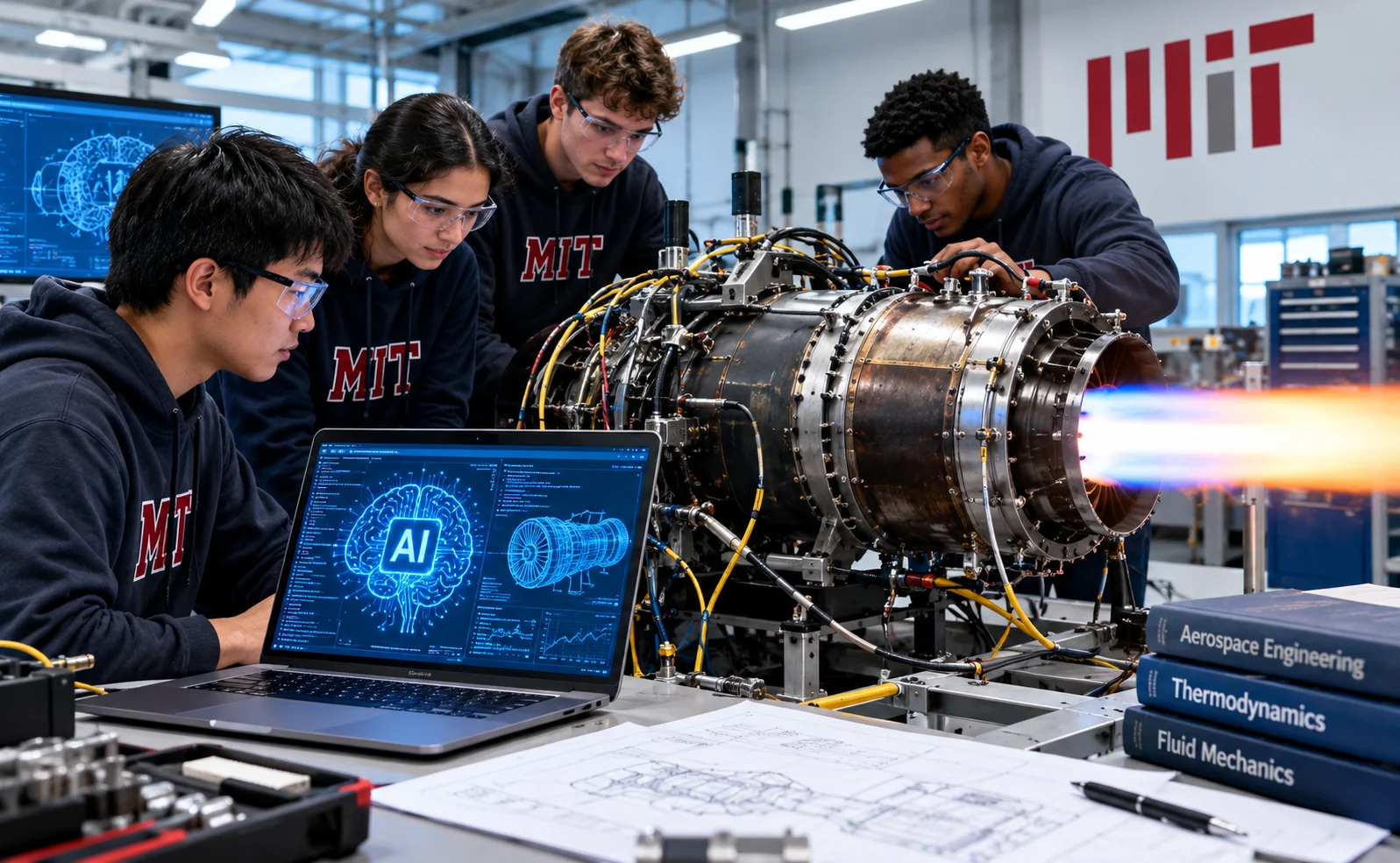
Artificial intelligence is increasingly moving beyond software and into the world of physical engineering. A recent experiment at the Massachusetts Institute of Technology (MIT) demonstrated just how far AI-assisted engineering can go, as 31 undergraduate students designed, built, assembled, and tested small jet engines in only four weeks as part of the inaugural JARVIS Challenge.
What Was the JARVIS Challenge?
The JARVIS Challenge, short for Jet-engine AI Research and Validation Intensive Sprint, was designed to examine whether generative AI and large language models could significantly speed up the traditionally lengthy process of designing and developing complex hardware.
Instead of spending months or years on a conventional engineering development cycle, participating students were given just four weeks to take a jet-engine concept from design to physical testing.
The challenge involved 31 MIT students divided into seven teams, with participants coming from nearly every department within MIT’s School of Engineering. Interestingly, not all of the students had extensive aerospace or gas-turbine experience. Some participants had limited knowledge of turbomachinery and compressible flows, while some younger students had not yet studied thermodynamics in depth.
AI Became an Engineering Partner
During the challenge, students were encouraged to use AI as a primary engineering partner. AI tools helped them with tasks such as researching technical information, comparing possible designs, exploring engineering concepts, writing and troubleshooting software, and investigating suppliers.
The students also had access to MIT Parley, a platform designed to bring multiple advanced large language models together through a single interface. This allowed the organizers to monitor how students interacted with AI systems, including the models they used and their prompts.
In addition to AI tools, teams had access to MIT’s machine shops, manufacturing facilities, commercial engineering software and testing equipment. Software available to participants included tools such as Concepts NREC, SolidWorks and ABAQUS.
The Goal: A Working Jet Engine
The challenge was not simply about creating a design on a computer. Teams had to produce a functioning single-spool gas-turbine aero engine.
The target was an engine capable of producing approximately 50–100 pounds of thrust, operating on Jet-A fuel, and completing five separate 60-second test runs.
Students were given considerable freedom over the engine’s design, materials and manufacturing approach. That made the competition a real-world test of whether AI could contribute to the entire engineering workflow rather than simply helping with individual calculations or documents.
AI Helped — But It Was Not Enough on Its Own
One of the most important lessons from the experiment was that AI could accelerate many parts of engineering, but it could not replace human engineering judgment.
Students found AI particularly useful during the early stages of the project, when they needed to quickly research unfamiliar subjects, compare possible approaches and generate ideas. However, physical engineering introduced challenges that were much harder for AI to understand.
A computer-generated design may appear technically reasonable, but manufacturing tolerances, material behavior, component availability, assembly problems and real-world testing can completely change the outcome.
MIT’s assessment was that engineering judgment remained the decisive factor. According to Professor Zolti Spakovszky, director of MIT’s Gas Turbine Laboratory, AI can substantially accelerate safety-critical hardware engineering, but engineers still need to understand when an AI-generated answer should be trusted and when it needs to be challenged.
Manufacturing Became a Major Bottleneck
Another important discovery was that faster design does not necessarily mean faster hardware development.
AI could help students research designs and make engineering decisions quickly, but the physical manufacturing process still required time. Parts had to be fabricated, suppliers had to deliver components and assemblies had to be physically tested.
This highlighted an important limitation of today’s AI systems: AI can generate information almost instantly, but it cannot instantly manufacture a precision mechanical component.
As a result, manufacturing and procurement became some of the biggest constraints during the four-week competition.
The Winning Team
The inaugural JARVIS Challenge was won by Team 811 Crew, which successfully tested its jet engine and produced net thrust. The team consisted of Anhad Sawhney, Yaakov Zerykier, Elizabeth Tupaj, Zachary Bleil and Ethan Wong.
Their success demonstrated that experience and engineering fundamentals remained extremely important, even when powerful AI systems were available to every team.
The result was particularly significant because the challenge was not intended simply to prove that AI could build a jet engine. Instead, it was designed to understand where AI provides the greatest advantage and where human expertise remains essential.
What the Experiment Means for the Future of Engineering
The MIT experiment could have implications far beyond student competitions.
AI-assisted engineering could potentially reduce the time required for early-stage research, design exploration, simulation, documentation and software development. Engineers could use AI to evaluate more design options in less time and quickly investigate unfamiliar technical subjects.
However, the experiment also demonstrates why AI should currently be viewed as an engineering accelerator rather than an autonomous engineer.
For safety-critical systems such as aircraft engines, spacecraft, medical equipment and industrial machinery, an AI-generated design still needs to be evaluated, manufactured and physically tested by qualified people.
The JARVIS Challenge therefore provides a more balanced picture of AI’s future in engineering. AI can make engineers faster and help them explore more possibilities, but human experience, practical knowledge and engineering judgment remain critical when digital designs have to work in the physical world.
Key Takeaways
- 31 MIT students participated in the challenge.
- Students were divided into seven teams.
- They had only four weeks to complete the project.
- Teams used AI as a major engineering partner.
- The target was a 50–100-pound-thrust gas-turbine engine.
- AI helped with research, design, software and technical decision-making.
- Manufacturing and physical testing remained major challenges.
- Team 811 Crew won the inaugural challenge.
- The experiment showed that AI can accelerate engineering, but human expertise and judgment remain essential.
Bottom line: MIT’s JARVIS Challenge offers a glimpse of a future in which engineers work alongside AI throughout the design and development process. The experiment suggests that the biggest opportunity may not be replacing engineers with AI, but giving engineers powerful AI assistants that allow them to work faster while keeping humans responsible for critical technical decisions.