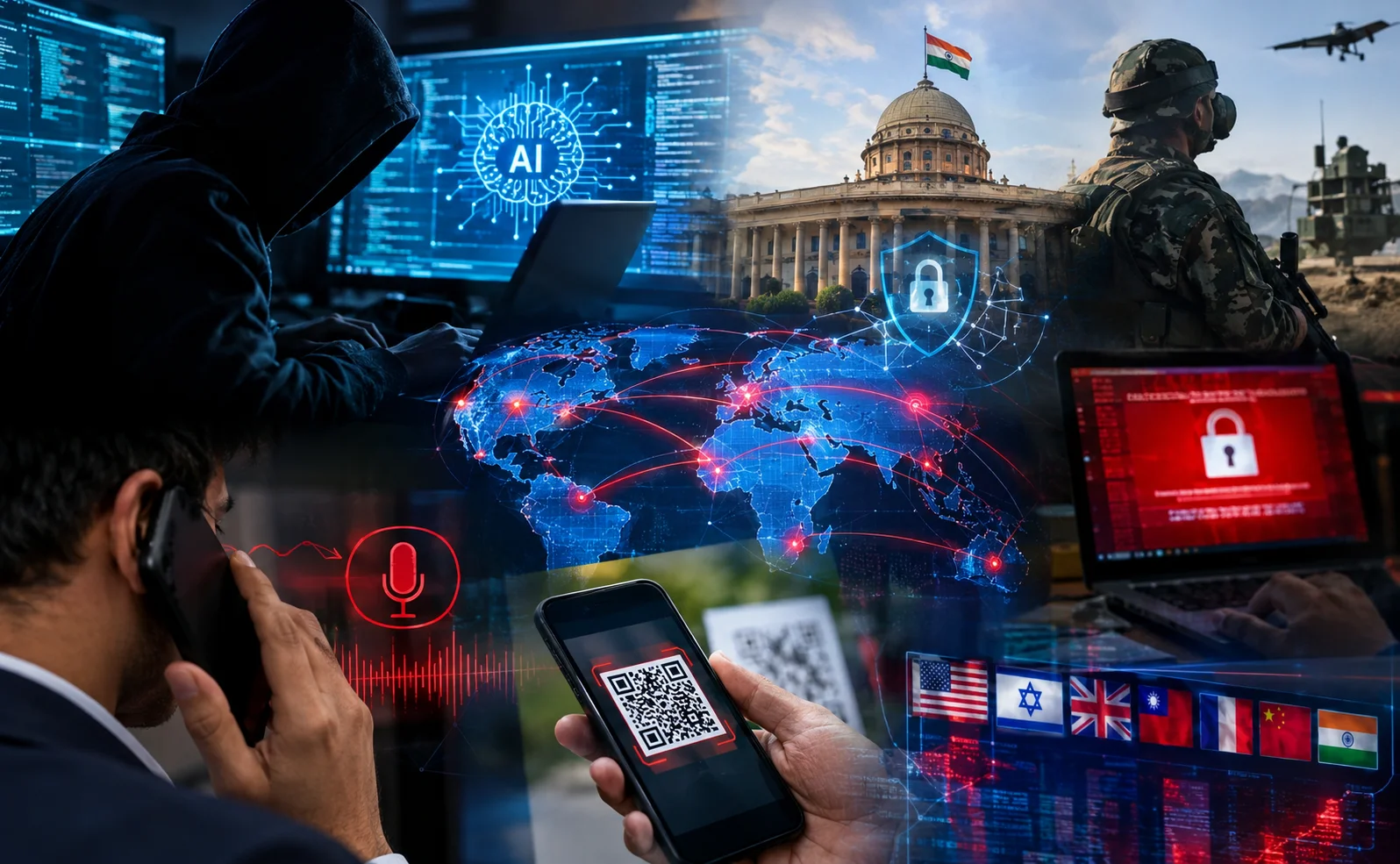
New Delhi: The cybersecurity landscape is undergoing a major transformation as artificial intelligence enables attackers to plan and execute sophisticated cyberattacks much faster than before. A report highlighted in the newspaper says that AI-assisted attacks can now be carried out within minutes, while governments have emerged as one of the most targeted sectors.
The report also points to a sharp increase in ransomware attacks against the defense sector, with such incidents rising nearly fivefold. At the same time, cybercriminals are increasingly using social-engineering techniques such as voice phishing and QR-code phishing to trick victims into revealing sensitive information.
AI is accelerating the cyberattack cycle
According to the report, attackers are increasingly using AI throughout different stages of a cyber operation. Instead of relying entirely on manual reconnaissance and preparation, criminals can use AI-enabled tools to identify potential targets, create convincing messages and automate parts of an attack.
This means the time between identifying a target and launching an attack can be dramatically reduced. The newspaper describes a scenario in which AI-assisted cyberattacks can move from preparation to execution within minutes.
The growing use of AI also makes traditional cybersecurity defenses more challenging because attackers can quickly modify their techniques and tailor attacks to individual victims or organizations.
Governments among the top targets
Government organizations are highlighted as a particularly attractive target because they hold large amounts of sensitive information and operate critical digital infrastructure.
The report’s country-wise data shows the United States accounting for 25.5% of the reported cyberattack targeting, followed by Israel at 7.6%, the United Kingdom at 4.8%, Taiwan at 3.9%, France at 3.8%, China at 2.8% and India at 2.5%.
These figures illustrate how cyber threats are distributed across countries, with major geopolitical and technologically important nations continuing to attract significant attention from cybercriminals and other threat actors.
Defense sector faces a major ransomware surge
One of the most significant findings is the reported increase in ransomware attacks against the defense sector.
The newspaper report says ransomware incidents in the sector have increased by around five times. Defense organizations are particularly sensitive targets because an attack can potentially disrupt operations while also putting confidential information and critical systems at risk.
The rise demonstrates that ransomware is no longer simply a financial threat. For organizations involved in national security and critical infrastructure, a successful attack can have much wider consequences.
Voice phishing rises 502%
The report also highlights a 502% increase in voice-phishing attacks.
Voice phishing, commonly known as vishing, uses phone calls or voice-based communication to manipulate victims into sharing confidential information, clicking malicious links or taking other actions that benefit attackers.
AI can make this type of fraud more convincing by helping criminals create highly personalized communications. As a result, employees may find it increasingly difficult to distinguish legitimate requests from carefully constructed fraudulent ones.
QR-code phishing becomes another major threat
The report cites 14.5 crore (145 million) QR-code phishing attacks.
QR-code phishing, often called quishing, uses malicious QR codes to redirect victims to fraudulent websites or other harmful destinations. Because people increasingly use QR codes for payments, authentication and accessing websites, attackers can exploit the familiarity of the technology.
A malicious QR code can appear in emails, messages, posters or other communications and may direct a victim to a fake login or payment page.
AI agents create a new security challenge
Another important finding in the report concerns the growing use of AI agents.
The report indicates that approximately 90% of attacks against AI agents can be associated with four major attack methods. This highlights a new cybersecurity challenge: organizations are not only required to protect conventional computer systems but also increasingly need to secure AI-powered systems and autonomous agents.
As AI agents gain access to information, applications and business processes, compromising them could potentially provide attackers with another route into organizational systems.
Digital transformation is expanding the attack surface
The report also points to the broader impact of rapid digital adoption. As businesses, governments and other institutions move more processes online, the number of systems, applications, accounts and connected devices that need protection continues to grow.
Cybercriminals are taking advantage of this expanding attack surface by combining traditional techniques with newer AI-assisted methods.
Key figures highlighted in the report
| Cybersecurity trend |
Reported figure |
| Increase in voice phishing |
502% |
| QR-code phishing attacks |
14.5 crore / 145 million |
| Increase in defense-sector ransomware |
Nearly 5× |
| United States’ share among listed top targets |
25.5% |
| Israel |
7.6% |
| United Kingdom |
4.8% |
| Taiwan |
3.9% |
| France |
3.8% |
| China |
2.8% |
| India |
2.5% |
Why this matters
The key change is not simply that cyberattacks are becoming more frequent. AI is reducing the time, effort and expertise required to conduct sophisticated attacks.
Organizations therefore need to strengthen multiple layers of security, including employee awareness, identity protection, monitoring, incident response, ransomware defenses and security controls around AI systems.
The report’s findings suggest that the cybersecurity battle is entering a new phase in which speed, automation and AI-powered social engineering could become as important as traditional malware and hacking techniques.
Bottom line: AI is making cyberattacks faster and potentially more scalable, while the sharp rise in voice phishing, QR-code attacks and defense-sector ransomware shows why governments, businesses and critical infrastructure organizations need to treat AI-era cybersecurity as a high-priority issue.