Culinary tourism is becoming an increasingly important part of the travel experience. For many travelers, visiting a new destination is not only about seeing famous landmarks but also about discovering local dishes, traditional ingredients, street food, markets, and regional cooking techniques.
As food becomes a bigger part of modern tourism, technology could make these experiences more informative and interactive. Researchers and technology developers are exploring inexpensive sensors that could work alongside smartphones to help identify and analyze food.
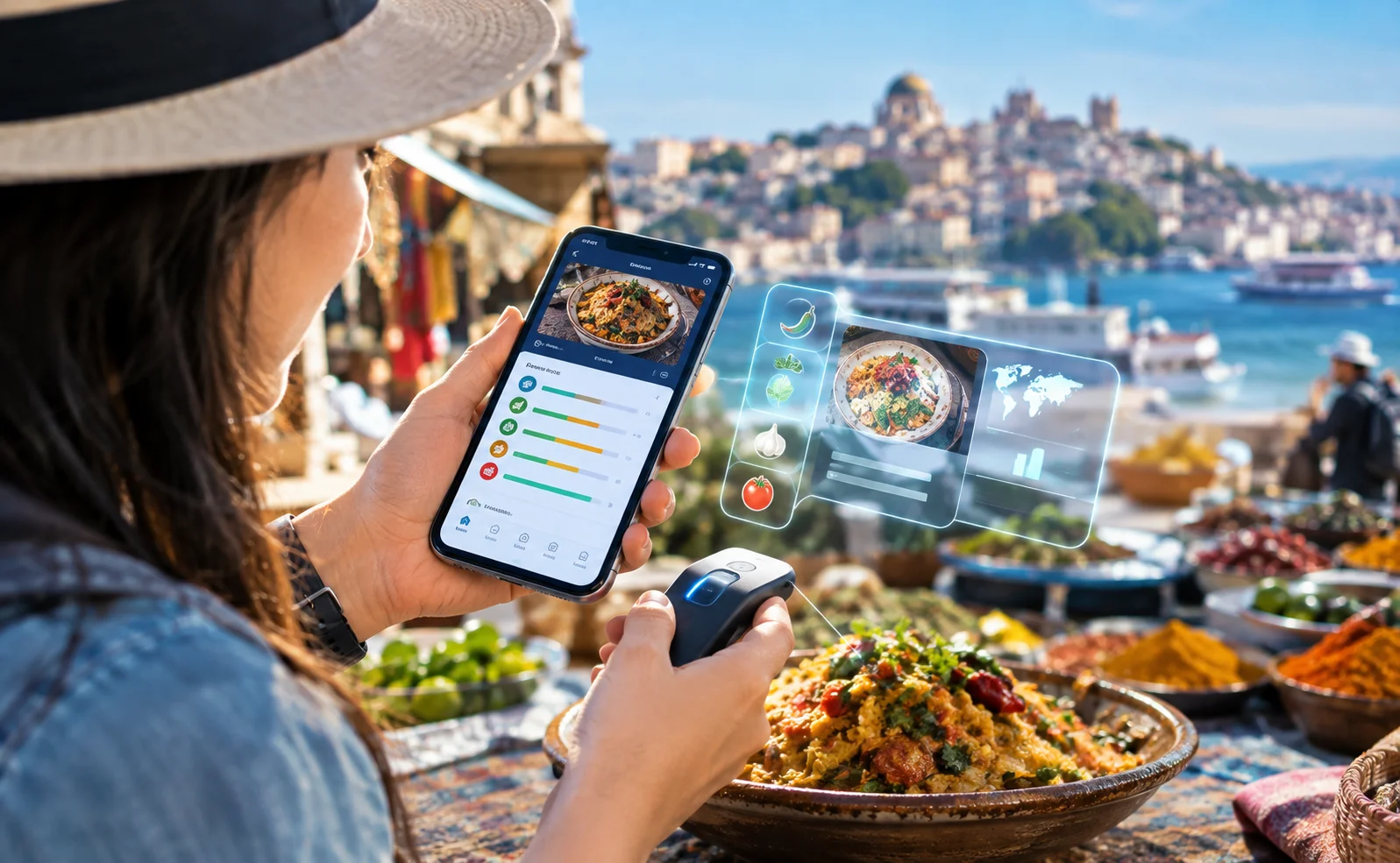
Instead of relying only on a photograph, future smartphone-based systems could potentially combine camera images, sensor readings, artificial intelligence, and location information to provide travelers with useful information about unfamiliar foods.
How Smartphone Technology Could Change Food Discovery
Smartphone cameras are already capable of recognizing many objects using artificial intelligence. A traveler can point a camera at a landmark, plant, animal, or product and receive information about it.
Food recognition is more complicated.
Different dishes can have similar appearances, while the same dish can look very different depending on how it is prepared. A photograph may show what a food looks like, but it cannot always reveal its ingredients or chemical characteristics.
This is where low-cost sensing technology could provide an additional layer of information.
A small sensor could potentially detect measurable characteristics associated with food and send the results to a smartphone application. AI software could then analyze those readings alongside visual information.
What Is a Food Sensor?
A food sensor is a device designed to detect specific physical or chemical properties of food.
Depending on the technology, sensors can potentially measure characteristics related to gases, acidity, moisture, temperature, volatile compounds, or other chemical signals.
Some researchers are investigating electronic sensing systems that can recognize patterns produced by different substances. These technologies are sometimes described as electronic noses or electronic tongues because they attempt to reproduce certain aspects of human smell or taste through sensors and computational analysis.
The objective is not necessarily to recreate the complete human sensory experience. Instead, the sensor collects measurable signals that software can analyze.
Combining Sensors With Artificial Intelligence
The real potential may come from combining inexpensive sensors with AI.
A sensor alone may produce a collection of measurements that are difficult for an ordinary user to interpret. Machine-learning algorithms can analyze these patterns and compare them with previously collected data.
For example, a system could potentially learn that certain combinations of sensor readings are commonly associated with particular ingredients or food categories.
When combined with an image from the smartphone camera, the AI model could have multiple sources of information to work with.
This approach could eventually make food-recognition applications more useful than systems that depend entirely on visual identification.
A New Tool for Culinary Travelers
Imagine walking through a traditional food market in an unfamiliar country.
You see a colorful ingredient or a prepared dish but do not know its local name. A smartphone application could use the camera to identify its appearance while a small sensor provides additional information.
The application could then potentially display:
- The likely name of the food
- Common ingredients
- Regional origin
- Traditional preparation methods
- Typical ways the food is served
- Cultural information
- Similar dishes found in other regions
Such a system could turn an ordinary food-market visit into a more interactive learning experience.
Helping Tourists Understand Local Cuisine
Food is closely connected to history and culture.
A traditional dish may represent centuries of local agricultural practices, migration, trade, religious traditions, or family cooking techniques.
Technology could help travelers understand this background while they are actually experiencing the food.
Instead of simply showing the name of a dish, a travel application could explain where its ingredients come from and how the dish became part of the local culture.
This could make culinary tourism more educational without taking away from the personal experience of discovering food.
Supporting Street Food Exploration
Street food is one of the most popular ways for travelers to experience local cuisine.
However, visitors may sometimes hesitate to try unfamiliar dishes because they do not know what they contain.
A food-recognition system could potentially provide basic information about ingredients and preparation characteristics.
It is important to note that a sensor should not automatically be treated as a guarantee that a food is safe to eat. Food allergies, contamination, preparation conditions, and cross-contact can involve factors that a consumer sensor may not detect reliably.
The technology could therefore serve as an information tool rather than a replacement for proper food-safety practices.
Helping People With Food Allergies
One potential application that could attract significant interest is ingredient awareness.
People with food allergies often need to know exactly what is contained in a meal. When traveling internationally, language barriers and unfamiliar recipes can make this more difficult.
In the future, sensor-assisted food-recognition systems might provide additional clues about the composition of certain foods.
However, this area requires particularly high accuracy. A consumer device should not be considered a definitive allergy-safety tool unless it has been scientifically validated for that specific purpose.
Accurate labeling and communication with food providers would remain essential.
Supporting Restaurants and Chefs
The technology could also have applications within the food industry.
Restaurants might use sensors to monitor ingredients, compare products, or study changes during cooking and storage.
Chefs and culinary researchers could potentially use data from sensors to better understand how ingredients change under different conditions.
For example, researchers could examine how aroma-related compounds change during cooking or how different ingredients influence the chemical profile of a dish.
This could create new opportunities for combining traditional culinary knowledge with modern technology.
A Tool for Food Quality Monitoring
Beyond tourism, low-cost sensors could potentially help with food-quality monitoring.
Certain measurable characteristics can change as food ages or is exposed to different storage conditions. Sensor systems could potentially detect patterns associated with these changes.
Businesses could use such technologies as an additional monitoring tool alongside established food-quality procedures.
For consumers, inexpensive sensors could eventually become another way to gather information about products before purchasing or consuming them.
The Importance of Local Food Databases
For a food-recognition system to work effectively around the world, technology companies and researchers would need large and diverse datasets.
Food varies considerably between countries and even between regions within the same country.
A particular dish may have multiple names, recipes, ingredients, and preparation methods. Regional variations could produce different sensor readings and visual appearances.
AI systems would therefore need to be trained using diverse examples from different cultures and cuisines.
Local chefs, food researchers, universities, tourism organizations, and communities could all potentially contribute valuable information.
Challenges in Recognizing Food
Although the concept is promising, several technical challenges remain.
Food is not a standardized product. The same dish can change depending on ingredients, cooking temperature, storage conditions, preparation techniques, and regional recipes.
Sensor readings can also be affected by environmental conditions.
A system trained using one type of food may not perform equally well when it encounters an unfamiliar variation.
For this reason, developers would need extensive testing across different foods, environments, and geographical regions.
Cost Could Make the Technology More Accessible
One of the most interesting aspects of smartphone-connected sensors is their potential affordability.
Advanced laboratory equipment can be expensive and difficult for ordinary travelers to access. Smaller sensors manufactured at scale could potentially make certain types of analysis more accessible.
A compact device connected to a smartphone could be easier to carry than traditional laboratory equipment.
However, low cost should not come at the expense of accuracy. Developers will need to find a balance between affordability, sensor quality, battery consumption, durability, and reliability.
Privacy and Data Considerations
Smartphone-based food technology could also generate interesting privacy questions.
If an application records what people eat, where they eat, and which restaurants or markets they visit, that information could potentially reveal detailed patterns about a person’s activities.
Developers would therefore need to think carefully about what data is collected, how long it is stored, and whether users can control or delete it.
Clear privacy settings would be particularly important if food-recognition applications become integrated with broader travel platforms.
The Future of Smart Culinary Tourism
The combination of smartphones, sensors, AI, and travel applications could create a new generation of culinary experiences.
Future travelers might use their phones not only to translate menus or identify dishes but also to explore the scientific, cultural, and geographic characteristics of the food they encounter.
A digital food guide could potentially recognize a dish, explain its history, identify common ingredients, recommend related local foods, and provide information about the region where those ingredients are produced.
This could make technology a bridge between travelers and local culinary traditions.
Technology Should Support Human Experience
Despite these possibilities, technology should not replace the human side of culinary tourism.
Food is more than a collection of chemical measurements. It is connected to people, traditions, memories, communities, and cultural identity.
A sensor may provide useful information, but a local chef explaining a family recipe or a market vendor describing an ingredient can offer something technology cannot easily reproduce.
The most useful systems will likely combine digital information with authentic human experiences.
Conclusion
As culinary tourism continues to grow, inexpensive smartphone-connected sensors could open new possibilities for discovering and understanding food.
By combining sensor data with smartphone cameras, artificial intelligence, travel databases, and location information, future applications could help travelers recognize unfamiliar foods and learn more about the ingredients and traditions behind them.
The technology still faces important challenges involving accuracy, food safety, regional variation, privacy, and affordability. It should therefore be viewed as an emerging tool rather than a perfect food-identification solution.
If researchers can overcome these challenges, smartphone-based sensing could become an interesting addition to the modern travel experience—helping people explore local cuisine with greater curiosity while discovering the science and culture behind the food they encounter.