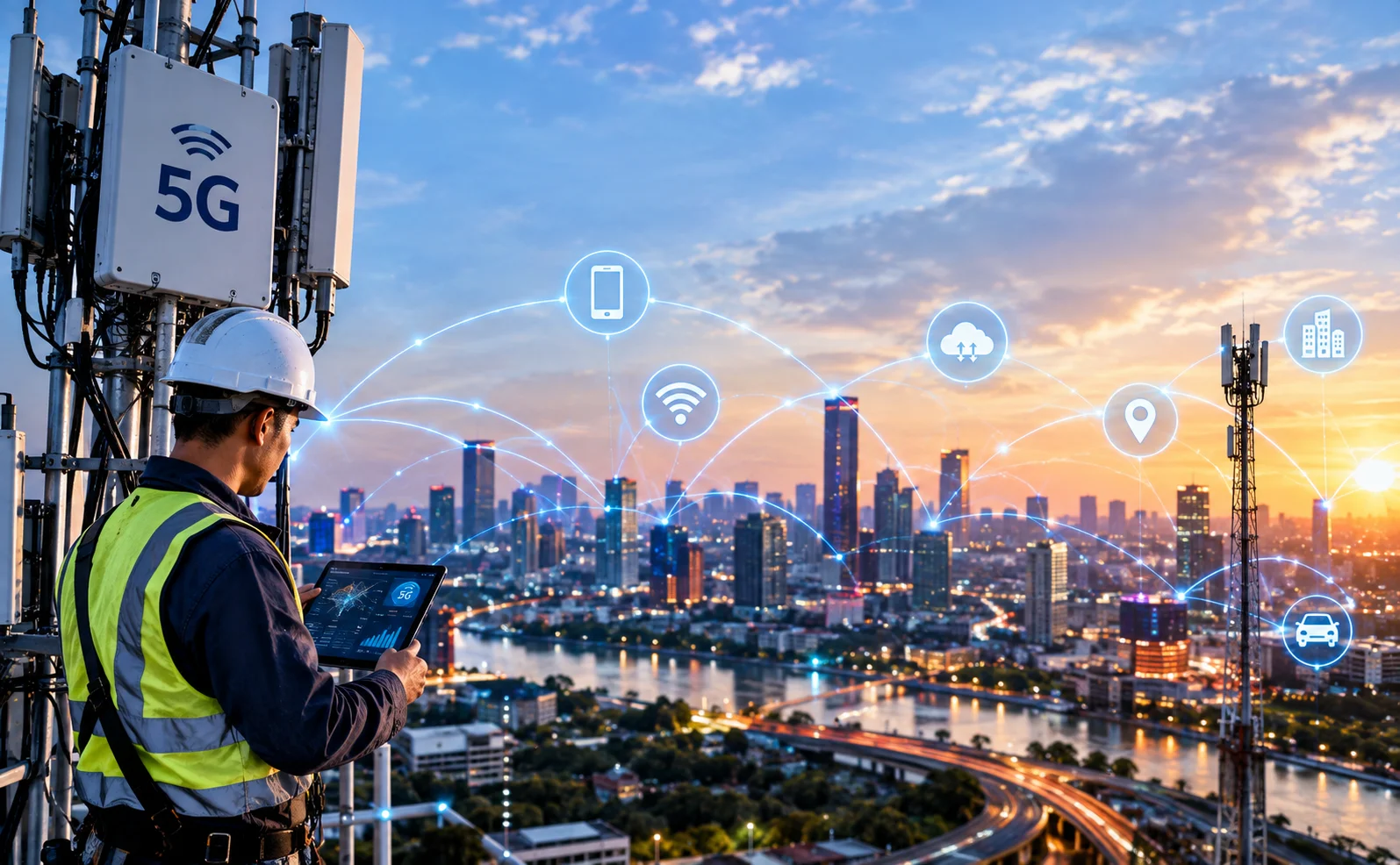
The global telecommunications industry is continuing to invest heavily in the expansion of 5G networks as demand for faster connectivity, reliable mobile services, and data-intensive applications grows. Network operators are upgrading infrastructure, deploying additional equipment, and improving coverage in both densely populated cities and underserved areas.
The expansion of 5G is not simply about increasing smartphone internet speeds. The technology is also expected to support connected devices, smart factories, autonomous systems, cloud applications, immersive experiences, and other emerging digital services.
What Is 5G Technology?
5G is the fifth generation of mobile network technology. It has been designed to provide higher data speeds, improved network capacity, and lower latency compared with previous generations of mobile connectivity.
One of its important characteristics is the ability to support a much larger number of connected devices within a network environment. This makes 5G relevant not only to smartphones but also to sensors, industrial equipment, vehicles, cameras, and other connected devices.
However, the actual performance of a 5G connection can vary depending on factors such as spectrum, network design, device compatibility, signal strength, congestion, and geographic conditions.
Why Telecommunications Companies Are Expanding 5G
Growing demand for mobile data is one of the major reasons operators continue to expand their networks.
People increasingly use smartphones for video streaming, cloud applications, gaming, online learning, social media, digital payments, and other data-heavy services. Businesses are also connecting more devices and moving workloads toward cloud-based platforms.
As these demands increase, telecommunications companies need to improve network capacity and coverage.
5G provides operators with additional capabilities that can help them manage these growing requirements.
Building More 5G Infrastructure
Expanding a mobile network requires much more than installing a new antenna.
Telecommunications providers may need to upgrade radio equipment, expand fiber connections, improve data-center capacity, deploy additional small cells, and modernize existing network infrastructure.
In urban areas, small-cell deployments can help provide additional capacity in locations where large numbers of users are concentrated.
Rural areas can present different challenges. Larger geographic distances, difficult terrain, and lower population density can make network deployment more expensive and technically challenging.
Different 5G Spectrum Bands
5G networks can operate across different portions of the radio spectrum, and each range has different characteristics.
Lower-frequency spectrum can travel relatively long distances and penetrate buildings more effectively, making it useful for broad coverage.
Mid-band spectrum offers a balance between coverage and capacity and has become an important part of many 5G deployments.
Higher-frequency bands can provide very high capacity and potentially extremely fast connections, but their signals generally travel shorter distances and can be more affected by physical obstacles.
Telecommunications providers therefore often combine different spectrum bands rather than relying on a single frequency range.
5G and Faster Mobile Experiences
For consumers, faster and more responsive mobile connectivity is one of the most visible benefits of 5G.
Improved network performance can support high-quality video streaming, faster downloads, cloud gaming, video calls, and other demanding applications.
However, the experience depends on the complete network environment. A 5G label alone does not guarantee a particular speed or latency level.
The quality of the device, network configuration, spectrum availability, and local conditions all influence performance.
5G and the Internet of Things
The Internet of Things, or IoT, is another important area where 5G can play a role.
Factories, warehouses, farms, transportation systems, and cities can use connected sensors and devices to collect information and automate certain processes.
For example, industrial equipment can send operational data to monitoring systems, while connected infrastructure can provide information about traffic, energy consumption, environmental conditions, or equipment performance.
The ability to support large numbers of connected devices can make advanced IoT deployments more practical.
Supporting Smart Cities
Cities are increasingly exploring connected infrastructure to improve the management of public services.
5G networks can provide connectivity for cameras, traffic-management systems, environmental sensors, public transportation systems, and other connected infrastructure.
Data from these systems can potentially help city authorities understand traffic patterns, monitor public infrastructure, and respond to changing conditions.
However, smart-city projects also require careful attention to privacy, cybersecurity, data governance, and infrastructure costs.
5G in Manufacturing
Manufacturing is one of the sectors where 5G could have a significant impact.
Factories can use wireless networks to connect machines, sensors, robots, cameras, and control systems. In certain environments, private 5G networks can provide organizations with dedicated connectivity for industrial operations.
Low-latency communication can be useful for applications where machines need to exchange information quickly.
Manufacturers are also exploring 5G for remote monitoring, predictive maintenance, automated inspection, and industrial robotics.
Private 5G Networks
Not every 5G deployment needs to be a public mobile network.
Private 5G networks can be established for specific organizations or locations, such as factories, ports, airports, campuses, warehouses, and large industrial facilities.
These networks can give organizations greater control over connectivity and network management.
Private wireless networks are becoming an area of interest for businesses that need reliable connectivity for specialized applications.
5G and Connected Vehicles
Transportation is another sector that could benefit from improved connectivity.
Connected vehicles can exchange information with cloud services, navigation platforms, infrastructure, and potentially other vehicles.
This connectivity can support applications such as traffic information, fleet management, remote diagnostics, navigation, and safety-related services.
However, critical transportation systems require extremely strong reliability and security standards. Connectivity should therefore be considered one part of a broader technological ecosystem.
The Role of Fiber Networks
Although 5G is a wireless technology, the expansion of high-speed mobile networks also depends heavily on wired infrastructure.
Base stations need connections to the wider telecommunications network, and fiber-optic infrastructure is often important for carrying large amounts of data.
This means 5G expansion can also encourage investment in fiber networks, data centers, cloud infrastructure, and other supporting technologies.
The combination of wireless and wired infrastructure creates the foundation for modern digital connectivity.
Network Security and 5G
As networks become more connected, cybersecurity becomes increasingly important.
5G infrastructure can connect large numbers of devices and support critical applications. A security weakness could therefore have consequences beyond an individual smartphone.
Telecommunications companies need to protect network equipment, authentication systems, customer information, connected devices, and data traffic.
Network monitoring, secure software updates, identity management, encryption, access controls, and continuous security testing are important elements of a strong security strategy.
Challenges of Global 5G Expansion
Despite its potential, 5G deployment involves significant challenges.
Network operators must invest in infrastructure, spectrum, equipment, fiber connections, maintenance, and skilled personnel.
Regulatory requirements can also influence how quickly new infrastructure can be deployed. Obtaining permissions for towers, small cells, and other equipment can take time in some regions.
Another challenge is ensuring that rural and underserved communities are not left behind as networks become more advanced.
The Digital Divide
The benefits of 5G will not automatically reach every community at the same speed.
Urban areas with high population density may receive new network infrastructure earlier because operators can potentially serve more customers from each deployment.
Remote and rural regions may require additional investment to make network expansion economically viable.
Governments, regulators, and telecommunications companies therefore face the broader challenge of expanding connectivity while ensuring that digital infrastructure remains accessible to different communities.
5G and Cloud Computing
The relationship between 5G and cloud computing is also becoming increasingly important.
Mobile devices and connected equipment can communicate with cloud platforms to access applications, storage, artificial intelligence, and data-processing capabilities.
At the same time, edge computing can move certain processing functions closer to users and connected devices.
Combining 5G, cloud computing, and edge infrastructure can support applications that require rapid data processing and responsive communication.
What Comes After 5G?
While 5G networks are still being expanded in many parts of the world, researchers and technology companies are already exploring future mobile technologies.
Research into next-generation connectivity focuses on greater capacity, improved efficiency, advanced sensing capabilities, artificial intelligence integration, and new forms of network architecture.
The transition from one generation of mobile technology to another takes many years, meaning 5G infrastructure will remain an important part of telecommunications for a long time.
What Consumers Can Expect
For everyday users, the expansion of 5G can mean broader coverage and improved connectivity in supported areas.
New smartphones and other devices increasingly include 5G capabilities, while network operators continue to improve coverage and capacity.
However, consumers should remember that network performance depends on location, device capability, subscription plans, spectrum, and local network conditions.
The practical benefits of 5G can therefore vary significantly between different locations.
Conclusion
Telecommunications providers are continuing to expand 5G infrastructure as demand for high-speed, reliable, and flexible connectivity increases.
The technology has applications far beyond faster smartphone downloads. From connected factories and smart cities to IoT devices, private networks, cloud computing, and connected transportation, 5G can become an important component of the broader digital infrastructure.
At the same time, successful deployment requires significant investment in spectrum, towers, fiber networks, cybersecurity, and supporting infrastructure. Ensuring that rural and underserved communities also benefit remains an important part of the wider connectivity challenge.
As 5G networks continue to mature, their impact will increasingly depend on the services and applications built on top of them. The combination of 5G with cloud computing, artificial intelligence, IoT, and edge computing could shape how people and businesses connect to digital services over the coming years.