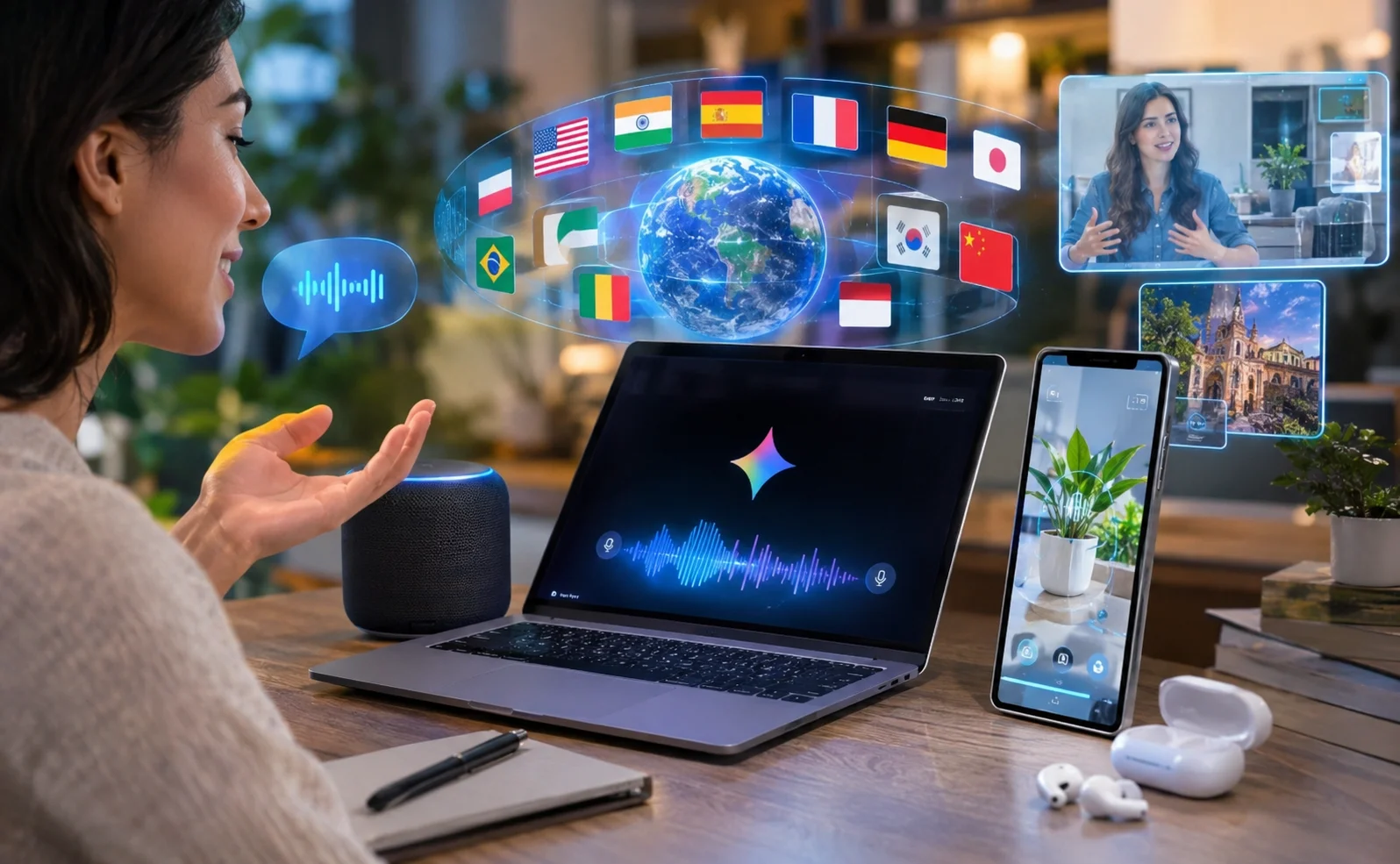
Google has expanded the capabilities of its latest Gemini 3.8 Live models, bringing more natural, real-time voice conversations, improved reasoning and multilingual support. According to Google, Gemini 3.8 Live can automatically detect and switch between 97 supported languages during a conversation, while also processing visual information in near real time.
Faster and More Natural Voice Conversations
The biggest focus of Gemini 3.8 Live is voice-based interaction. Instead of treating every voice request as a simple question-and-answer exchange, the new model is designed to maintain a more continuous conversation.
Google says Gemini 3.8 Live can perform tasks in the background while continuing to communicate with the user. This means an AI assistant can acknowledge a request, work on it through connected tools or APIs and continue the conversation instead of forcing the user to wait silently.
Support for 97 Languages
Language support is another major part of the update. Google says Gemini 3.8 Live supports 97 languages and can transition between supported languages during an ongoing conversation. This could make voice-based AI more useful in multilingual environments, where users naturally switch languages while speaking.
Google has also been expanding Gemini’s language capabilities specifically in India. Gemini Live now supports more than 25 Indian languages and dialects, according to Google, including languages such as Hindi, Sanskrit, Bhojpuri and Maithili.
AI Can Understand What Users See
Gemini 3.8 Live is not limited to audio. The model can process visual inputs in near real time, allowing conversations to incorporate information from what the user is looking at. Google describes applications such as visual assistance, interactive learning and AI agents that can respond based on both spoken instructions and visual context.
Extended Thinking for Complex Tasks
Google has also introduced Gemini 3.8 Live Extended Thinking, designed for more complicated tasks that require multiple steps of reasoning. The company says the model can reason while maintaining an uninterrupted voice conversation, providing progress cues as it works through a task.
Gemini’s Broader AI Expansion
The Gemini 3.8 rollout comes alongside several other AI developments from Google. Gemini 3.8 Flash was introduced in September 2026 as a model focused on reasoning, coding and agentic workflows, while Gemini 3.8 Flash TTS and Flash-Lite TTS have expanded Google’s AI-generated audio capabilities.
For Indian users, Google’s AI expansion has also included AI Mode and Search Live in additional Indian languages. Google says Search Live enables users to interact with Search through voice and camera, providing real-time help based on what the camera sees.
OpenAI’s AI Usage Shows a Different Side of the AI Revolution
The second report visible in the newspaper focuses on how OpenAI itself is using AI internally. Recent reporting based on OpenAI’s internal usage data indicates that researchers are using AI substantially more for execution-oriented tasks such as coding, technical assistance, infrastructure work and debugging than for high-level decision-making.
The reported figures show approximately:
| Work area |
AI-assisted usage |
| Research & infrastructure coding |
198,200 tokens/researcher/day |
| Technical help & review |
158,800 |
| Launching, monitoring & debugging |
133,100 |
| Experimental-results analysis |
40,200 |
| Research/experiment planning |
5,100 |
| Deciding project focus |
2,300 |
| Computing & staffing decisions |
1,500 |
| Continue/stop decisions |
200 |
These figures illustrate an important distinction: AI assistance is being used heavily for tasks with relatively measurable outputs, while activities involving prioritisation, strategic judgement and decisions about whether to continue a project have much lower reported AI usage.
What This Means for the Future of AI
Together, these developments point toward a broader shift in artificial intelligence—from systems that simply answer questions toward AI assistants capable of listening, seeing, reasoning, using tools and completing multi-step tasks.
At the same time, the OpenAI data suggests that human judgement continues to play an important role in areas involving priorities and strategic decisions. The technology is therefore increasingly being positioned as a tool for accelerating execution, while humans remain involved in many higher-level choices.
Bottom line: Gemini 3.8’s 97-language voice capabilities and real-time visual understanding demonstrate how quickly conversational AI is becoming more multimodal and interactive, while OpenAI’s internal usage data highlights where AI assistance is currently being adopted most heavily inside an AI-focused organisation.