
















Technology News | October 3, 2026
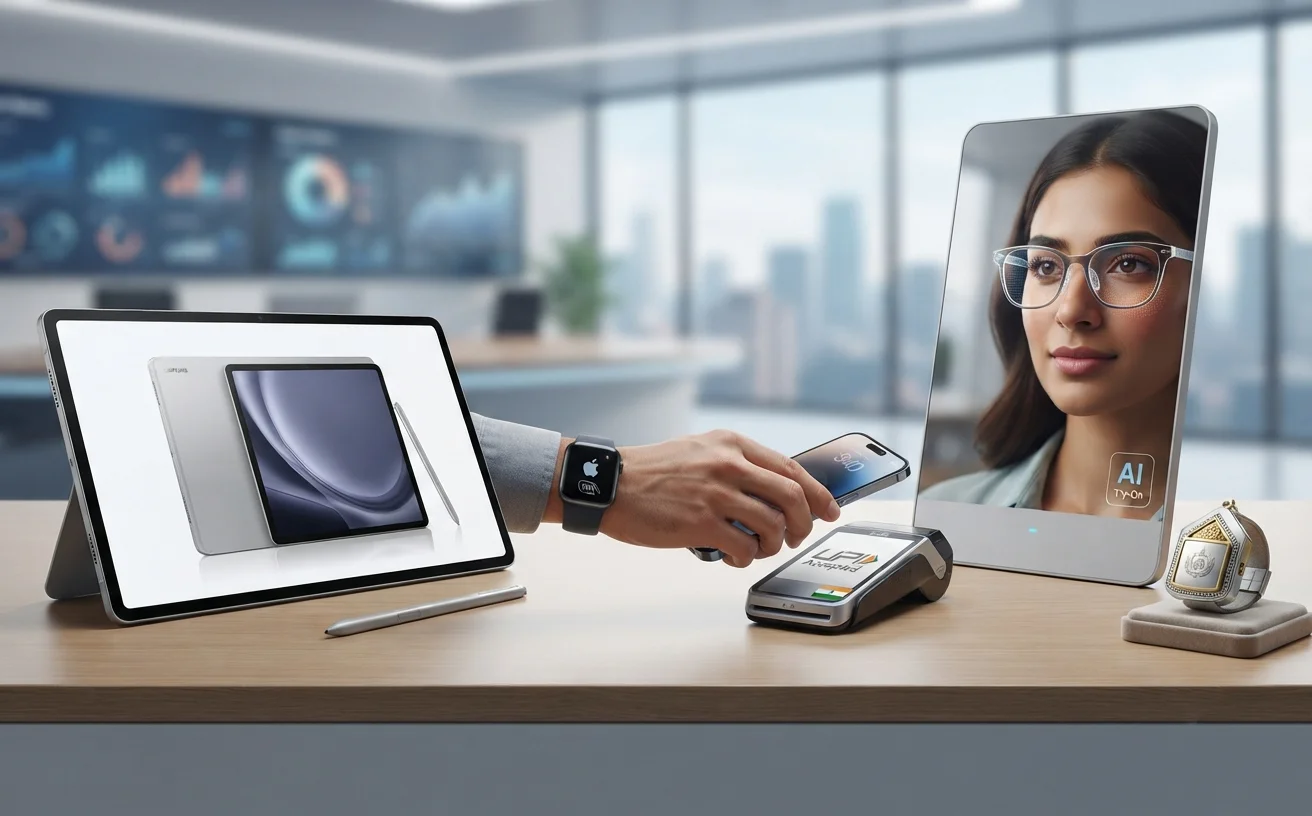
The technology industry is witnessing a fresh wave of innovation, with major developments spanning premium tablets, digital payments, artificial intelligence, online shopping, and next-generation wearable devices. Samsung has introduced its Galaxy Tab S12 series in India, Apple Pay has officially arrived in the Indian market, and AI-powered virtual try-on technology is changing how consumers shop for clothes online.
Meanwhile, Zomato founder Deepinder Goyal has revealed six colour options for Temple, his experimental health wearable, with pre-orders expected to begin soon.
These developments highlight how technology is becoming increasingly integrated into everyday activities, from shopping and payments to productivity and personal health monitoring.
Here is a detailed look at the latest developments, their features, and what they could mean for consumers.
1. Samsung Galaxy Tab S12 Series Launched in India: Premium Tablets With Galaxy AI and Adobe Photoshop

Samsung has introduced its new Galaxy Tab S12 series, featuring two premium Android tablets: the Galaxy Tab S12 Ultra and Galaxy Tab S12+.
The new lineup focuses on productivity, creative work, entertainment, and AI-powered features. Samsung is combining high-performance hardware with its Galaxy AI ecosystem to provide users with a more versatile tablet experience.
One of the most notable additions is the pre-installed Adobe Photoshop application, bringing advanced photo-editing capabilities directly to the tablet platform. Samsung is also including an S Pen in the box, making the devices suitable for digital drawing, note-taking, and precision editing.
Samsung Galaxy Tab S12 Series: Price in India
|
Model |
Starting price |
|---|---|
|
Galaxy Tab S12+ |
₹1,29,999 |
|
Galaxy Tab S12 Ultra |
₹1,49,999 |
Prices announced by Samsung India on October 1, 2026.
Key Specifications
|
Feature |
Galaxy Tab S12 Ultra |
Galaxy Tab S12+ |
|---|---|---|
|
Display |
Dynamic AMOLED 2X |
Dynamic AMOLED 2X |
|
Processor |
MediaTek Dimensity 9500 |
MediaTek Dimensity 9500 |
|
RAM |
12GB |
12GB |
|
Storage |
256GB / 512GB |
256GB / 512GB |
|
Rear camera |
13MP + 8MP ultra-wide |
13MP |
|
Front camera |
12MP ultra-wide |
12MP ultra-wide |
|
Battery |
11,600mAh |
10,600mAh |
|
Charging |
45W |
45W |
|
Connectivity |
5G, Wi-Fi 7 |
5G, Wi-Fi 6E |
|
Stylus |
S Pen included |
S Pen included |
|
Durability |
IP68 |
IP68 |
Adobe Photoshop Comes to Samsung Tablets
The inclusion of Adobe Photoshop is a major addition for creative professionals. Users can edit images, work with layers, refine designs, and perform other visual editing tasks without depending entirely on a desktop computer.
Samsung is also offering a four-month Photoshop plan with the new tablets, adding value for users interested in creative applications.
Multitasking and Productivity
The Galaxy Tab S12 series is designed to support demanding workflows, including document editing, video conferencing, digital illustration, and multitasking.
With its large AMOLED display and S Pen support, the tablets can serve as portable alternatives to traditional laptops for selected professional and educational tasks.
Samsung has announced that sales will begin on October 7, 2026, through Samsung’s official online store, exclusive stores, partner retailers, and other online platforms.
2. AI Virtual Try-On Technology: Try Clothes Online Before Buying

Artificial intelligence is transforming online shopping by introducing virtual try-on experiences that allow customers to preview clothing before placing an order.
Traditionally, online shoppers have relied on product photographs, size charts, and customer reviews to decide whether an outfit will suit them. However, these methods cannot always provide an accurate impression of how a garment might look on an individual.
AI-powered virtual try-on technology aims to address this limitation by generating a visual preview of clothing on a user’s image.
How Does AI Virtual Try-On Work?
The technology combines computer vision, machine learning, and image-generation techniques to create realistic clothing previews.
A typical experience involves the following steps:
-
The user selects a clothing item from an online store.
-
They upload a suitable photograph or select an available model.
-
The AI system analyses the person’s body position and image.
-
The technology generates a preview showing the selected garment on the person.
-
The user can compare different styles and outfits before making a purchase.
Benefits for Online Shoppers
Better purchasing decisions: Customers can get a visual idea of how an outfit might look before ordering.
Convenience: Virtual previews reduce the need to visit physical stores simply to explore different styles.
Personalised shopping: AI can make product discovery more interactive by allowing users to visualise clothing on their own photographs.
Potentially fewer returns: Better visual information may help shoppers make more informed choices, although virtual try-on cannot guarantee the correct fit or size.
The Technology Behind the Experience
AI virtual try-on systems use image segmentation, pose estimation, garment recognition, and generative models to preserve important visual details while adapting clothing to a person’s image.
More advanced systems can attempt to reproduce fabric folds, garment structure, lighting, and body positioning to create a natural-looking result.
However, virtual try-on should be understood as a visualisation tool rather than a precise measurement system. Actual fit, fabric quality, colour, and comfort can still differ from the digital preview.
As online retailers continue adopting AI-based shopping experiences, virtual try-on could become an increasingly common feature across fashion platforms.
3. Apple Pay Officially Launches in India: iPhone and Apple Watch Users Can Now Make Contactless Payments

Officially launched September 30, 2026
Apple Pay has officially launched in India, bringing Apple’s contactless payment service to one of the world’s largest digital payment markets.
The service is initially available to eligible Axis Bank credit card customers using Visa and Mastercard networks. Users can add supported cards to Apple Wallet and make payments through compatible Apple devices at participating merchants.
The launch marks an important expansion of Apple’s financial services in India, where consumers are already familiar with mobile payments and digital wallets.
Supported Apple Devices
-
iPhone
-
Apple Watch
-
iPad
-
Mac support is expected to follow.
Apple Pay can be used for eligible in-store, in-app, and online transactions.
How to Set Up Apple Pay in India

Step 1: Open Apple Wallet
Launch the Wallet app on a compatible iPhone or iPad and tap the plus (+) button to begin adding a payment card.

Step 2: Add an eligible Axis Bank card
Follow the on-screen instructions to add a supported Axis Bank Visa or Mastercard credit card. Customers can also add eligible cards through the Axis Bank mobile banking app.

Step 3: Authenticate and pay
Use Face ID, Touch ID, or your device passcode to authorise payments at compatible contactless terminals or supported online checkouts.
Security and Privacy Features
Apple Pay uses tokenisation technology, which means the actual card number is not shared with merchants during transactions. Instead, a device-specific payment token is used to process payments.
Transactions are also protected by authentication mechanisms such as Face ID, Touch ID, or a passcode.
This approach is designed to improve payment security while making transactions more convenient.
What About UPI?
Apple Pay’s India launch does not mean that it replaces UPI. The service currently supports eligible card-based payments, while UPI remains a separate payment system with its own apps and infrastructure.
For consumers, Apple Pay adds another option for contactless payments, particularly for those who already use Apple devices and eligible Axis Bank credit cards.
4. Temple Wearable: Deepinder Goyal Reveals Six Colours Ahead of Pre-Orders

Deepinder Goyal has revealed six colour options for Temple, an experimental wearable device focused on health monitoring and brain-related measurements.
The announcement has generated interest because Temple is not designed as a conventional smartwatch or fitness tracker. Its stated technological direction centres on measuring brain blood flow using a system referred to as BrainFlow.
Goyal shared the colour options on October 2, 2026, and indicated that pre-orders could begin as early as the following week. People who have joined the early-access waitlist are expected to receive priority access.
Six Temple Launch Colours

True Gold

Rose Gold

Black Mirror
Real Jade
Deep Blue

Purple Funk
Colour names are based on the launch announcement. Images are illustrative and may not represent the final retail product.
What Is Temple Designed to Do?
Temple is being developed as a wearable that aims to monitor brain-related physiological signals, particularly cerebral blood flow.
The device’s BrainFlow technology is intended to measure changes in blood flow to the brain continuously. This could open new possibilities for research and personal health monitoring if the technology is validated and performs reliably outside controlled environments.
Key Areas of Interest
-
Continuous measurement of brain blood-flow signals.
-
Wearable form factor designed for everyday use.
-
A focus on brain-related health data rather than conventional step counting alone.
-
Experimental sensing technology that may support future research applications.
It is important to distinguish between a device’s intended capabilities and clinically established medical functions. Temple’s measurements should not be treated as a medical diagnosis unless and until the relevant capabilities are independently validated and appropriately approved.
Pre-Orders and Availability
The company is aiming to open pre-orders soon, potentially during the week beginning October 5, 2026. However, the final schedule depends on outstanding preparations.
The device’s final retail price, complete technical specifications, and broader availability have not yet been confirmed in the reports.
What These Technology Developments Mean for Consumers
The four developments highlight how technology companies are addressing different aspects of everyday life.
|
Technology |
What is changing? |
Consumer impact |
|---|---|---|
|
Samsung Galaxy Tab S12 |
AI-powered productivity and creative tools |
More capable tablets for work and entertainment |
|
AI virtual try-on |
Digital visualisation of clothing |
More interactive online shopping |
|
Apple Pay |
Contactless payments on Apple devices |
Additional payment convenience for eligible cardholders |
|
Temple wearable |
Experimental brain-health monitoring |
New possibilities for personal physiological data |
Each development represents a different stage of technological adoption. Samsung’s tablets and Apple Pay are available or approaching retail availability, while Temple remains an emerging product with important details still to be announced. AI virtual try-on, meanwhile, is a broader technology trend rather than a single product launch.
Final Thoughts
From Samsung’s premium tablets to Apple’s expansion into contactless payments, the latest technology news demonstrates how digital innovation is becoming more closely connected to everyday consumer experiences.
AI is also reshaping online shopping by helping customers visualise products before buying, while experimental wearables such as Temple are exploring new ways to collect and interpret health-related data.
The most significant takeaway is that technology is moving beyond traditional devices and interfaces. Whether through smarter tablets, personalised shopping experiences, secure digital wallets, or advanced wearables, the next phase of innovation is focused on making digital services more intuitive, accessible, and integrated into daily life.
As these products evolve, their long-term success will depend on practical usefulness, privacy, reliability, affordability, and the trust they build with consumers.