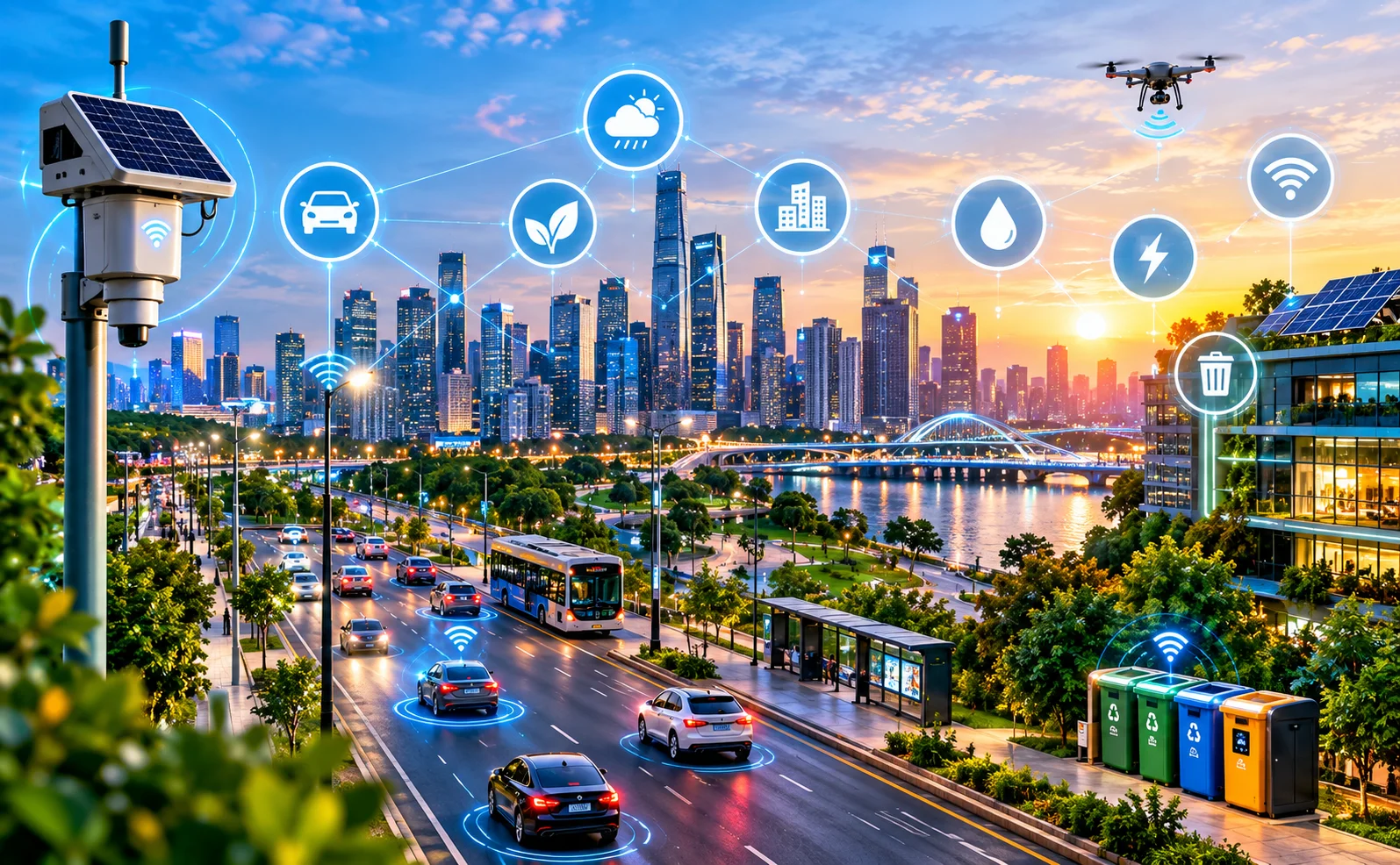
Cities around the world are increasingly turning to connected technologies to improve the way urban infrastructure operates. One of the most important developments in this transformation is the integration of sensor networks into smart city projects.
From monitoring traffic and air quality to managing street lighting, water systems, waste collection, and public infrastructure, connected sensors are becoming an important part of modern urban planning. These systems can continuously collect information and provide city authorities with data that can help them understand changing conditions and respond more efficiently.
The development of sensor-enabled infrastructure represents a shift from traditional city management toward data-driven and connected urban environments.
What Are Smart City Sensor Networks?
A smart city sensor network is a collection of connected devices installed throughout an urban area to monitor physical conditions and collect useful information.
These sensors can measure a wide range of factors, including:
- Traffic movement
- Air quality
- Temperature and humidity
- Noise levels
- Water consumption
- Energy usage
- Parking availability
- Street lighting conditions
- Waste-bin capacity
- Road and infrastructure conditions
The information collected by these devices can be transmitted to centralized platforms where it can be analyzed by software and city management teams.
Instead of relying entirely on manual inspections, authorities can use real-time or regularly updated information to understand what is happening across different parts of a city.
How Sensor Networks Are Changing Urban Management
Traditional city management often depends on scheduled inspections and reports. While these methods remain important, connected sensors can provide a continuous stream of information.
For example, a traffic sensor can detect changes in vehicle movement and help identify congestion. Similarly, an air-quality sensor can monitor pollution levels in different locations and provide data that can be analyzed over time.
This approach can help city planners identify patterns and make infrastructure decisions based on actual conditions rather than relying only on assumptions or periodic observations.
Smart Traffic Management
Traffic congestion is one of the most common challenges faced by growing cities.
Smart traffic systems can use sensors, cameras, connected signals, and data-processing platforms to monitor traffic conditions. Information from these systems can help identify heavily congested roads and changing traffic patterns.
In some smart city projects, traffic signals can be coordinated according to traffic conditions. Parking sensors can also provide information about available spaces, potentially reducing the amount of time drivers spend searching for parking.
Connected transportation systems may also support public transit by providing information about vehicle locations, route conditions, and passenger demand.
Intelligent Street Lighting
Street lighting is another area where sensor technology can play an important role.
Traditional streetlights often operate according to fixed schedules. Smart lighting systems can incorporate sensors that detect environmental conditions, movement, or other predefined factors.
Connected lighting infrastructure can provide city operators with information about individual lights and help identify equipment that requires maintenance.
Some systems can also adjust lighting levels according to local conditions, potentially improving operational efficiency while maintaining appropriate illumination.
Monitoring Air Quality
Air pollution is a major concern in many urban areas, particularly in densely populated locations.
Smart city sensor networks can place air-quality monitoring devices across different neighborhoods. These sensors may measure pollutants and environmental conditions and send the information to centralized monitoring platforms.
A larger network of monitoring points can provide a more detailed picture of how air quality varies across a city.
The resulting data can support environmental research, urban planning, and public information systems.
Smarter Water Management
Water infrastructure is another important application of connected sensors.
Smart water systems can monitor water flow, pressure, consumption, and other conditions across distribution networks. Sensors may help identify unusual changes that could indicate leaks or infrastructure problems.
For consumers, smart meters can provide more detailed information about water usage. For utility operators, connected monitoring systems can make it easier to understand demand patterns and identify potential problems.
Efficient water management is particularly important for cities dealing with increasing populations and limited resources.
Waste Management Becomes More Connected
Waste collection can also benefit from sensor technology.
Smart waste bins can be equipped with sensors that monitor their fill levels. Instead of relying exclusively on fixed collection schedules, waste-management teams can use information from connected bins to identify locations that require attention.
This approach may help improve route planning and reduce unnecessary collection trips.
When combined with broader city-management platforms, waste data can also help planners understand waste-generation patterns across different areas.
Smart Parking Systems
Finding a parking space can be a frustrating experience in busy urban areas.
Smart parking systems use sensors and connected platforms to monitor parking availability. Depending on the system, information can be displayed through mobile applications, digital signs, or other interfaces.
Drivers can potentially find available spaces more efficiently, while city authorities can gain a better understanding of parking demand.
Digital parking systems can also be integrated with payment platforms and other transportation services.
The Role of the Internet of Things
The Internet of Things, commonly known as IoT, is one of the technologies supporting smart city development.
IoT allows physical devices and sensors to communicate with software platforms and other connected systems.
In a smart city environment, thousands of devices may collect information from roads, buildings, vehicles, utility networks, public spaces, and other infrastructure.
The real value comes from connecting these individual systems so that information can be analyzed together.
For example, traffic information could potentially be combined with public transportation data, weather conditions, and road information to provide city planners with a broader understanding of transportation patterns.
Artificial Intelligence and Data Analysis
Sensor networks generate large amounts of information. Simply collecting data is not enough; cities also need systems capable of processing and interpreting it.
Artificial intelligence and advanced data analytics can help identify patterns within large datasets.
For example, analytical systems may identify unusual traffic patterns, changes in energy consumption, or recurring infrastructure problems.
Machine-learning technologies can potentially help cities move from reactive maintenance toward predictive approaches, where certain problems are identified before they become major disruptions.
Smart Buildings and Energy Management
Smart city development also extends into individual buildings.
Modern buildings can use connected sensors to monitor temperature, occupancy, lighting, energy consumption, and other conditions.
Building-management systems can use this information to improve operational efficiency and provide facility managers with greater visibility into how buildings are being used.
When large numbers of buildings are connected to wider city infrastructure, the resulting data can contribute to broader energy-management strategies.
Public Safety and Emergency Response
Connected infrastructure can also support emergency-management systems.
Sensors can provide information about environmental conditions, infrastructure status, traffic movement, and other factors that may be relevant during emergencies.
For example, connected systems can help identify unusual conditions in certain areas and provide information to response teams.
However, emergency applications require careful system design because reliability, security, and data accuracy are particularly important in critical situations.
Challenges of Smart City Technology
Despite the potential benefits, smart city development also presents several challenges.
Data Privacy
Connected devices can collect large amounts of information. Cities therefore need clear policies governing what information is collected, how it is stored, who can access it, and how long it is retained.
Privacy considerations become particularly important when systems involve information that can be associated with individuals.
Cybersecurity
The more connected devices a city operates, the larger its potential digital attack surface becomes.
Smart infrastructure needs strong cybersecurity measures, regular software updates, access controls, monitoring, and contingency plans.
A security problem affecting critical infrastructure could have consequences beyond the digital environment.
Cost of Infrastructure
Installing thousands of sensors and connecting them to centralized platforms requires significant investment.
Cities also need to consider long-term maintenance, software updates, replacement hardware, connectivity costs, and technical support.
Successful smart city programs therefore require long-term planning rather than simply purchasing new technology.
Interoperability Is Becoming Increasingly Important
Smart city infrastructure often involves equipment from different manufacturers and technology providers.
If these systems cannot communicate with one another, cities may end up with disconnected platforms that provide limited value.
Open standards and interoperable technologies can help different systems exchange information more effectively.
For example, transportation, energy, water, environmental monitoring, and public-service platforms could potentially share relevant information through secure interfaces.
What Smart Cities Could Look Like in the Future
The future of smart city development is likely to involve greater connectivity between different forms of urban infrastructure.
A city could potentially combine information from transportation systems, energy networks, environmental sensors, buildings, and public services into a unified digital environment.
Digital twins are another emerging concept. A digital twin can represent aspects of a physical environment digitally, allowing planners and engineers to analyze conditions and model potential changes.
Such technologies could help cities evaluate infrastructure projects before implementing them in the physical world.
Benefits for Residents
The ultimate purpose of smart city technology is not simply to install more connected devices. The goal is to improve urban services and make cities more efficient, responsive, and sustainable.
For residents, successful implementations could contribute to:
- More efficient transportation
- Better infrastructure maintenance
- Improved environmental monitoring
- More responsive public services
- Better parking management
- More efficient energy usage
- Improved waste collection
- More informed urban planning
The actual benefits, however, depend on how effectively technology is designed, implemented, maintained, and integrated into existing city systems.
The Growing Importance of Data-Driven Urban Planning
As urban populations continue to grow, cities are facing increasingly complex challenges. Managing transportation, energy, water, waste, and infrastructure requires access to reliable information.
Sensor networks can provide a continuous source of data that helps planners understand how urban systems behave.
Combined with analytics, cloud computing, artificial intelligence, and IoT technologies, this information can support more informed decision-making.
However, technology should complement human planning rather than replace it. Infrastructure decisions still require consideration of local communities, budgets, environmental conditions, accessibility, and long-term development goals.
Final Thoughts
The integration of sensor networks into smart city projects represents an important step toward more connected urban infrastructure.
From intelligent traffic management and smart parking to environmental monitoring, energy management, water systems, and waste collection, connected sensors can provide valuable information about how cities operate.
At the same time, smart city development must address important issues such as privacy, cybersecurity, cost, interoperability, and long-term maintenance.
As these technologies continue to develop, the most successful smart city projects are likely to be those that combine advanced technology with practical urban planning and a clear focus on improving everyday services for residents.