Robotics technology is transforming the manufacturing industry by introducing new levels of automation, precision, flexibility, and operational efficiency. From automotive production lines to electronics assembly and warehouse operations, modern robots are becoming an essential part of industrial processes.
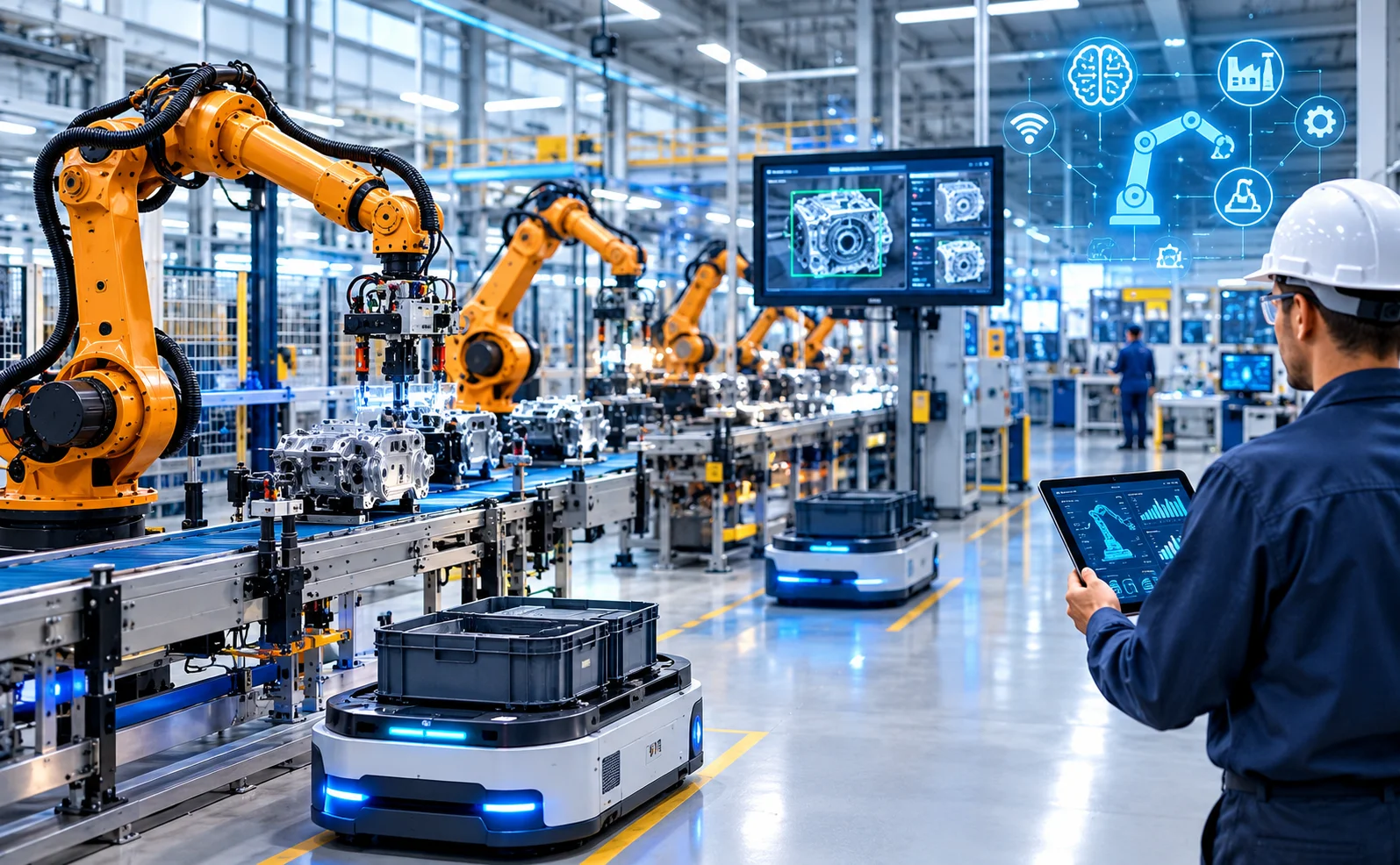
Recent advances in artificial intelligence, machine vision, advanced sensors, and robotic control systems are expanding the role of robots beyond repetitive factory tasks. Manufacturers can now deploy robotic systems for complex operations such as quality inspection, material handling, precision assembly, and adaptive production.
As industries face increasing demands for productivity, product quality, and operational flexibility, robotics is helping businesses rethink how factories are designed and managed.
How Robotics Is Changing Modern Manufacturing
Traditional manufacturing automation generally relied on machines programmed to perform specific repetitive operations. While effective for high-volume production, these systems could be difficult to adapt when product designs or production requirements changed.
Modern robotics introduces greater flexibility through software-controlled movements, intelligent sensors, and improved integration with manufacturing systems.
Industrial robots can now support multiple stages of production, including:
- Automated assembly and component installation
- Welding and metal fabrication
- Painting and surface finishing
- Material transportation
- Product packaging
- Quality inspection
- Machine tending
- Warehouse operations
These applications allow manufacturers to automate tasks that require consistency, repeatability, and precise movement.
Major Robotics Innovations Driving Manufacturing
1. AI-Powered Industrial Robots
Artificial intelligence is expanding the capabilities of industrial robots.
Traditional robotic systems generally follow predefined instructions, while AI-enabled systems can analyze sensor information and respond to changing conditions within their designed operating limits.
Machine learning and computer vision can support applications such as identifying components, recognizing defects, and adjusting robotic operations based on visual information.
For example, an AI-assisted inspection robot can examine manufactured components for surface irregularities and classify potential defects for further review.
These capabilities can help manufacturers improve inspection consistency and reduce dependence on manual visual checks.
2. Collaborative Robots (Cobots)
Collaborative robots, commonly known as cobots, are designed for applications where robots and human workers operate in shared workspaces under appropriate safety measures.
<AsyncImageGroup query={[“collaborative industrial robot cobot working beside factory technician manufacturing”,”collaborative robot arm precision assembly factory workstation”]} aspectRatio=”16:9″ layout=”bento”/>
Unlike many traditional industrial robots that operate inside restricted safety cells, cobots may use force sensing, speed monitoring, and other safety technologies to support human-robot collaboration.
Common applications include:
- Small component assembly
- Machine loading and unloading
- Packaging
- Screw fastening
- Inspection assistance
- Repetitive workstation tasks
Cobots can be useful for manufacturers that need automation without redesigning an entire production line.
However, collaborative operation still requires a proper risk assessment, safety configuration, and suitable workplace design.
3. Advanced Machine Vision and Robotic Inspection
Machine vision enables robots to interpret visual information using cameras, image processing, and AI-based recognition systems.
This technology is increasingly used in manufacturing quality control.
Robotic vision systems can help identify:
- Missing components
- Incorrect assembly
- Surface defects
- Product alignment issues
- Packaging irregularities
- Dimensional variations
In electronics manufacturing, vision-guided robots can assist with positioning small components that require accurate placement.
Combining robotic movement with advanced inspection systems can improve process consistency and provide manufacturers with additional quality data.
4. Autonomous Mobile Robots in Factories
Autonomous mobile robots (AMRs) are changing how materials move within manufacturing facilities.
These robots use sensors, cameras, mapping technology, and navigation software to move materials between designated locations.
Unlike conventional fixed-route automated guided vehicles, many AMRs can dynamically navigate around obstacles and adapt to changing facility conditions.
Typical applications include:
- Transporting raw materials
- Moving components between production stations
- Delivering tools and supplies
- Supporting warehouse inventory movement
- Transferring finished products
AMRs can reduce unnecessary manual transportation and help improve the flow of materials across a facility.
Applications of Robotics Across Different Manufacturing Industries
Automotive Manufacturing
The automotive sector is one of the most established users of industrial robotics.
Robots are commonly deployed for welding, painting, body assembly, material handling, and inspection.
Modern robotic systems also support flexible production lines capable of handling different vehicle configurations.
Electronics Manufacturing
Electronics production requires precise handling of small components and consistent assembly operations.
Robotic systems support circuit board handling, component placement, inspection, and packaging.
Advanced vision systems can help identify positioning errors and manufacturing defects.
Food and Beverage Manufacturing
Robotics is increasingly used in food processing, sorting, packaging, palletizing, and material handling.
Automated systems can support consistent packaging operations and reduce direct human contact with products in suitable production environments.
Food-grade equipment and sanitation requirements remain important considerations.
Pharmaceutical Manufacturing
Robotics supports several pharmaceutical production activities, including packaging, laboratory automation, material handling, and inspection.
In controlled environments, robotic systems can help maintain repeatable procedures and support traceability requirements.
Metal and Heavy Equipment Manufacturing
Robotic welding, cutting, grinding, and material handling are important applications in metal fabrication.
Robots can perform repetitive operations with consistent positioning, while workers focus on programming, supervision, maintenance, and specialized tasks.
Benefits of Robotics in Manufacturing
Improved Production Efficiency
Robots can perform suitable repetitive tasks continuously according to production schedules, helping manufacturers increase equipment utilization.
Higher Precision and Consistency
Robotic systems can repeat programmed movements with high consistency, supporting applications where accuracy is important.
Better Workplace Safety
Robots can be deployed for certain hazardous, physically demanding, or repetitive tasks, reducing workers’ direct exposure to those activities.
Reduced Production Errors
Automated assembly and inspection systems can help identify process variations and reduce certain categories of manufacturing defects.
Greater Production Flexibility
Modern programmable robots can be reconfigured for different tasks, product types, or production requirements.
Improved Data Collection
Connected robotic systems can generate operational information that helps manufacturers monitor production performance, equipment condition, and process efficiency.
The Role of Robotics in Smart Factories
Smart factories combine robotics with technologies such as the Industrial Internet of Things (IIoT), cloud computing, artificial intelligence, and manufacturing execution systems.
In these environments, machines and production systems exchange information to coordinate operations.
For example, a connected production line may use sensor data to monitor equipment performance, while a robotic system performs material handling and an inspection station checks product quality.
This integration can support:
- Real-time production monitoring
- Predictive maintenance
- Automated quality reporting
- Production scheduling
- Equipment performance analysis
- Better coordination between manufacturing stages
The objective is not simply to install more robots, but to create a connected production environment where equipment, software, and workers can operate more effectively together.
Challenges of Implementing Robotics in Manufacturing
Despite its benefits, robotics adoption involves several important challenges.
High Initial Investment
Industrial robots, integration, safety equipment, software, and facility modifications can require significant upfront spending.
Technical Skills Requirements
Manufacturers need trained professionals for robot programming, system integration, maintenance, and troubleshooting.
Integration With Existing Equipment
Older production lines may require upgrades before they can communicate effectively with modern robotic systems.
Cybersecurity Risks
Connected industrial robots and factory networks introduce cybersecurity considerations. Manufacturers need suitable access controls, network protection, and monitoring.
Maintenance and Downtime
Robots require preventive maintenance, calibration, spare parts, and technical support to maintain reliable operation.
Workforce Transition
Automation can change job responsibilities and required skills. Training and workforce development are important parts of responsible implementation.
Future Trends in Industrial Robotics
The future of manufacturing robotics is expected to involve greater intelligence, connectivity, and adaptability.
More Intelligent Robotic Systems
AI and machine vision are expected to support more complex inspection, object recognition, and production tasks.
Increased Use of Collaborative Robots
Cobots may continue expanding into small and medium-sized manufacturing facilities as suitable applications and integration options develop.
Digital Twins
Digital twins can create virtual representations of manufacturing equipment or production processes, allowing engineers to simulate and evaluate changes before applying them to physical systems.
Predictive Maintenance
By analyzing operational data, manufacturers can identify patterns associated with equipment wear and schedule maintenance more effectively.
Flexible Production Lines
Reprogrammable robotic systems can help manufacturers respond to changing product designs, order volumes, and production requirements.
Human-Robot Collaboration
Future factories are likely to combine robotic precision and repeatability with human problem-solving, supervision, creativity, and technical expertise.
How Robotics Is Reshaping the Manufacturing Workforce
Robotics is changing the nature of industrial work.
As repetitive operations become increasingly automated, demand may grow for skills related to:
- Robotics programming
- Automation engineering
- Industrial maintenance
- Machine vision
- Data analysis
- Mechatronics
- Safety system management
The impact on employment varies by industry, region, company size, and the type of automation introduced.
Workforce training and reskilling can help employees adapt to changing production environments and new technical responsibilities.
Final Thoughts
Robotics innovations are creating new opportunities across the manufacturing industry. AI-powered robots, collaborative automation, autonomous mobile systems, and advanced machine vision are expanding what factories can automate.
These technologies can support improved efficiency, consistent quality, safer task allocation, and more flexible production processes.
However, successful implementation requires careful planning, skilled workers, appropriate safety measures, cybersecurity protection, and a clear understanding of operational requirements.
As robotics continues to evolve, the future of manufacturing will increasingly depend on how effectively businesses combine intelligent machines, connected systems, and human expertise.
The transformation is not only about making factories more automated. It is about building manufacturing environments that are more adaptable, connected, and capable of meeting changing industrial demands.