Introduction
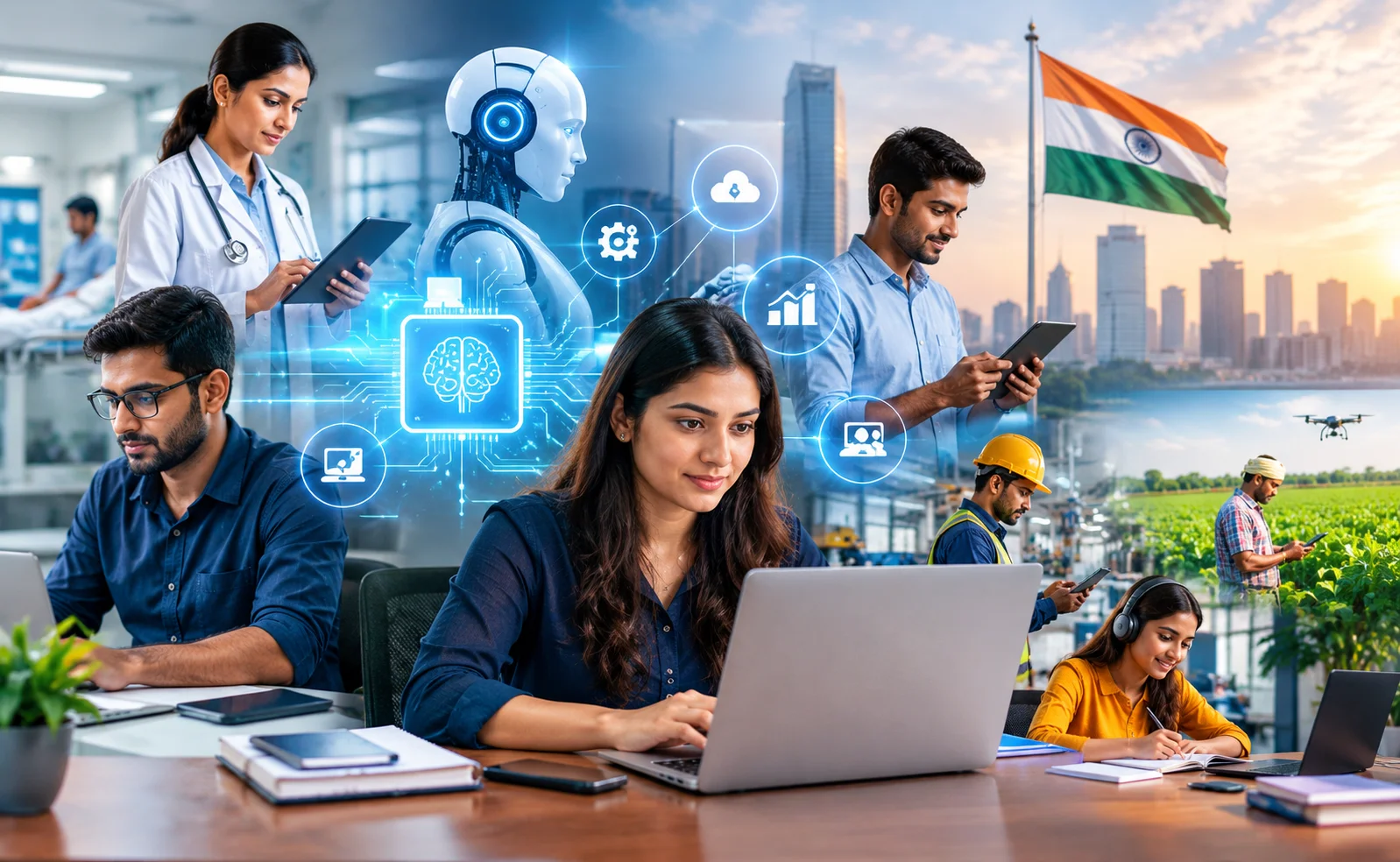
Artificial Intelligence (AI) is becoming an important part of India’s changing employment landscape. From technology companies and banks to hospitals, educational institutions, factories, and small businesses, organizations are exploring new ways to use AI to improve productivity, reduce repetitive work, and deliver better services.
In 2026, the influence of AI on employment is becoming more visible. Some workers are using intelligent tools to complete everyday tasks faster, while businesses are looking for employees who can combine professional knowledge with digital skills. At the same time, the growing use of automation is raising questions about traditional job roles, entry-level opportunities, and the skills people will need in the future.
India is particularly important in this transformation because of its large workforce, expanding digital economy, established IT industry, and growing startup ecosystem. AI adoption could create new opportunities for innovation, but its benefits will depend partly on how effectively workers, businesses, educational institutions, and policymakers prepare for the changes.
India’s government highlighted the growing importance of AI skills and workplace productivity in a February 2026 backgrounder. It also emphasized the need to develop workforce capabilities so that technological progress supports employment and inclusive growth. <Cite refs={[“turn287888search1″,”turn287888search0”]}/>
So, how exactly is AI changing jobs in India? Here are seven major developments shaping the workplace in 2026.
1. AI Is Automating Repetitive Office Tasks
One of the most noticeable effects of AI is its ability to handle certain repetitive, rule-based tasks. Many organizations spend considerable time processing documents, organizing information, answering routine questions, preparing summaries, and entering data into business systems.
AI-powered tools can assist with these activities, allowing employees to spend more time on work that requires judgment, communication, and problem-solving.
For example, an office employee may use AI to summarize a lengthy report, organize meeting notes, draft a routine email, or identify important information in a large document. A customer support team might use an AI assistant to suggest answers to common questions before a human representative reviews them.
Which jobs are affected?
- Data entry and document processing
- Routine administrative support
- Basic customer service
- Report preparation
- Repetitive information management
This does not mean that every job in these categories will disappear. Many roles include responsibilities that require human understanding, exception handling, and accountability.
Instead, the mix of tasks within a job may change. Employees who learn to use AI responsibly can become more effective at managing their workloads.
What does this mean for Indian workers?
Businesses may increasingly expect employees to understand digital workflows and use AI tools appropriately. Workers who can check AI-generated information, identify mistakes, and manage exceptions may offer more value than those who rely entirely on manual processes.
The key change is not simply that machines can complete tasks. It is that employees may need to learn new ways of organizing their work.
2. The IT Industry Is Moving Beyond Traditional Coding
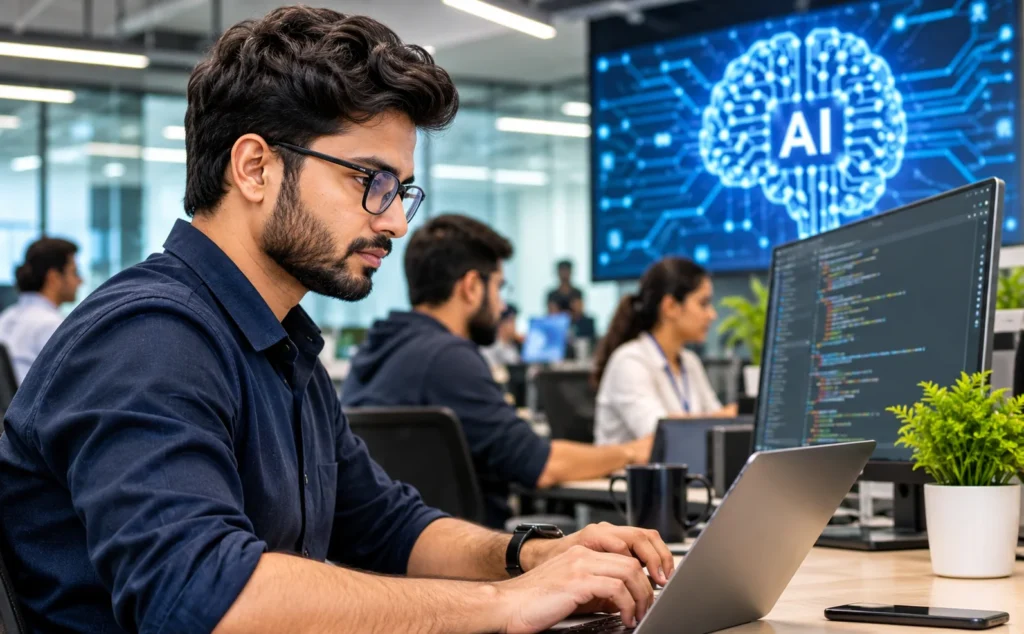
India’s information technology industry has long supported software development, technical services, cloud computing, and global business operations. AI is now changing how many of these services are delivered.
AI coding assistants can suggest program structures, generate basic code, explain unfamiliar functions, and help developers identify potential errors. Testing tools can also assist with creating test cases and identifying problems in software applications.
These capabilities can speed up parts of the software development process, but they do not remove the need for skilled professionals.
Human developers still need to understand business requirements, choose appropriate technical approaches, evaluate security risks, review generated code, and ensure that software behaves correctly.
Emerging areas of opportunity
AI adoption is creating or expanding work in areas such as:
- AI and machine learning development
- Data engineering and analytics
- Cloud infrastructure
- Cybersecurity
- AI application testing
- Software integration
- AI governance and quality evaluation
Indian companies that serve international clients may also need professionals who can integrate AI into existing business systems.
How are expectations changing?
Employers may place greater emphasis on practical skills, project experience, and the ability to work with modern tools. A qualification can still be valuable, but demonstrating that you can solve real problems is also important.
For students and early-career professionals, learning programming fundamentals remains useful. AI tools can support learning, but understanding how software works is necessary to recognize incorrect suggestions and build reliable applications.
The future of IT work is likely to involve a combination of technical knowledge, AI-assisted development, critical thinking, and communication.
3. AI Is Changing Hiring and Recruitment
Recruitment is another area where AI is influencing everyday business operations. Organizations receive large numbers of applications, and recruitment teams often need to organize candidate information, coordinate interviews, and manage communication.
AI-powered recruitment systems can assist with sorting applications according to defined criteria, drafting job descriptions, scheduling interviews, and answering routine questions from applicants.
These systems may help recruitment teams manage administrative workloads, but their use also creates important concerns.
How AI can support recruitment
An AI assistant may help a recruiter organize applications, identify skills mentioned in resumes, prepare interview questions, or summarize information for further review.
Recruiters can then spend more time evaluating relevant experience, discussing job expectations, and understanding candidates’ strengths.
Why human oversight matters
AI systems can make mistakes or reflect bias in the data and criteria used to design them. A candidate might be overlooked because their experience is described differently from the wording in a job advertisement.
For this reason, employers should not treat automated recommendations as unquestionable decisions. Recruitment processes need appropriate human review, clear criteria, and safeguards for personal information.
What job seekers should do
Candidates can prepare for changing recruitment practices by:
- Keeping resumes clear and accurate
- Describing relevant skills with specific examples
- Building a portfolio of completed projects where appropriate
- Practising communication and problem-solving
- Learning about the tools used in their chosen industry
AI may change how applications are processed, but professional ability and relevant experience remain essential parts of a strong application.
4. AI Is Creating New Career Opportunities
Although discussions about AI often focus on automation, the technology is also increasing demand for specialized skills and creating new responsibilities within existing organizations.
Businesses need people who can develop AI systems, connect them to company workflows, maintain supporting infrastructure, assess outputs, protect sensitive information, and ensure that automated processes work properly.
India’s expanding digital ecosystem provides opportunities for professionals with different levels of technical experience, although the qualifications required vary considerably between roles.
AI-related career paths to explore
AI and machine learning engineering: These professionals develop, evaluate, and improve systems that learn from data.
Data analysis: Analysts organize information, identify patterns, and help businesses make evidence-based decisions.
Cybersecurity: Security professionals protect digital systems, investigate threats, and help organizations manage risks associated with increasingly connected technologies.
AI product management: Product managers help determine how AI features should solve real customer problems and coordinate their development.
AI quality evaluation: Specialists test AI outputs, identify weaknesses, and assess whether systems meet defined standards.
AI implementation and consulting: These professionals help organizations identify suitable uses for AI and integrate tools into existing processes.
AI governance and compliance: Specialists help businesses establish rules for responsible AI use, privacy, transparency, and risk management.
Not every AI-related role requires the same level of programming knowledge. Some focus on business operations, research, communication, or risk management, while others require advanced technical expertise.
The most suitable path depends on an individual’s interests, education, experience, and willingness to learn.
5. AI Is Transforming Banking, Healthcare, and Education
AI’s influence extends well beyond technology companies. Industries across India are exploring ways to use intelligent systems to improve service delivery and support professional decision-making.
Banking and financial services
Banks and financial institutions can use AI to identify unusual transaction patterns, assist with fraud detection, answer routine customer questions, and analyze large amounts of financial information.
These applications can help employees investigate potential problems more efficiently. However, financial decisions still require appropriate controls, and automated systems must be monitored for errors and unfair outcomes.
Healthcare
Healthcare organizations can use AI to help organize medical information, support administrative work, and assist qualified professionals with certain image-analysis and decision-support tasks.
For example, AI may help summarize patient records or identify areas that require further review. Such tools are not substitutes for qualified medical professionals, who must interpret results in context and make appropriate clinical decisions.
Education
Teachers and educational organizations can use AI to prepare learning materials, generate practice questions, explain difficult concepts, and adapt educational resources to different learning needs.
These applications can reduce some preparation work, giving educators more time to focus on students, classroom discussions, and individual support.
Manufacturing and logistics
Factories can use AI to monitor equipment, identify quality issues, and help predict when maintenance may be needed. Logistics businesses can use intelligent systems to assist with demand forecasting, inventory planning, and route management.
In these environments, AI often works alongside human employees who understand physical operations and respond to unexpected situations.
Why this matters for employment
AI is changing not only which tasks people perform, but also how different professions operate. Employees who combine industry-specific knowledge with appropriate AI skills may be better prepared to adapt.
For example, a teacher who understands educational methods, a nurse familiar with patient care, or a finance professional experienced in risk assessment can bring important context that a general-purpose AI system does not independently possess.
6. Small Businesses and Startups Can Do More With Limited Resources
AI is making certain business capabilities more accessible to small companies and entrepreneurs. Tasks that once required several separate tools or substantial outside assistance can sometimes be managed with affordable AI-enabled services.
This is especially relevant in India, where small businesses operate across retail, manufacturing, professional services, tourism, education, and online commerce.
Practical examples of AI use
A small online shop may use AI to draft product descriptions, organize customer feedback, or prepare marketing ideas.
A local service provider might use an AI assistant to draft customer emails, prepare appointment reminders, or translate basic business information into different languages.
A startup could use AI to create an early website draft, summarize market research, prepare presentation materials, or support customer-service workflows.
A small manufacturer may explore AI-assisted quality checks or equipment monitoring where suitable infrastructure is available.
How this affects jobs
AI can help small teams handle more work without increasing administrative effort at the same rate. It can also make it easier for entrepreneurs to test new ideas and establish digital services.
At the same time, businesses need people who understand their customers, maintain relationships, make decisions, and ensure that automated work is accurate.
AI does not guarantee business success. Results depend on the quality of the tools, the business model, customer demand, available resources, and the owner’s ability to use the technology responsibly.
For many small businesses, the most practical approach is to begin with one clearly defined task, measure whether the tool saves time or improves quality, and expand its use only when the results justify it.
7. AI Is Increasing the Importance of Upskilling and Reskilling
One of the most significant changes in India’s employment landscape is the growing importance of continuous learning.
A person may have strong professional experience today, but the tools and processes used in their industry can change over time. AI is accelerating this shift by introducing new ways to perform familiar tasks and creating demand for additional capabilities.
The World Economic Forum’s 2025 analysis of India’s employment outlook highlighted the need for stronger technical skills alongside analytical thinking, creativity, adaptability, and continued workforce training. <Cite refs={[“turn287888search0″,”turn287888search6”]}/>
What is upskilling?
Upskilling means improving skills that are relevant to your current job.
For example, a marketing professional may learn to use AI for campaign research, while a software developer may learn to evaluate AI-generated code.
What is reskilling?
Reskilling means learning capabilities that help you move into a different role or area of work.
For example, an administrative professional might study data analysis or digital operations to prepare for a different career path.
Skills worth developing in 2026
AI literacy: Understand what AI tools can do, where they fail, and how to use them responsibly.
Data literacy: Learn how to interpret information, identify patterns, and check whether conclusions are supported by evidence.
Communication: Explain ideas clearly, ask useful questions, and collaborate effectively.
Critical thinking: Evaluate information instead of accepting every AI-generated answer as correct.
Problem-solving: Break complicated tasks into manageable steps and choose appropriate solutions.
Digital security awareness: Understand how to protect accounts, sensitive documents, and business information.
Industry knowledge: Develop a strong understanding of the profession in which you want to work.
A simple learning plan
Beginners do not need to master every AI technology at once. A practical starting point is to identify one repetitive task in a chosen field and learn how AI can assist with it.
Next, practise checking the results, understand the tool’s limitations, and build a small project that demonstrates what you have learned.
As confidence improves, learners can explore more advanced skills relevant to their career goals.
The objective is not simply to use AI frequently. It is to use it thoughtfully to produce accurate, useful, and responsible work.
Is AI Replacing Jobs in India or Creating New Ones?
The relationship between AI and employment is more complicated than a simple choice between job losses and job creation.
Some tasks can be automated, and certain roles may require fewer people or undergo substantial redesign. Other positions may become more productive when employees use AI as an assistant. New opportunities can also emerge as organizations develop and adopt AI-based services.
The effect differs according to the occupation, industry, organization, and type of task involved.
India’s labour market includes a wide range of work, from agriculture and physical services to advanced technology and professional occupations. AI will not affect all these activities in the same way.
Routine digital work may be particularly suitable for automation, while jobs requiring physical presence, interpersonal trust, complex judgment, or responsibility for people can involve different challenges and opportunities.
There are also reasons to be cautious. Workers may not have equal access to training, and some employees could find it difficult to move into new roles. Businesses, educational institutions, and policymakers therefore have important responsibilities in supporting workforce transitions.
The goal should be to introduce AI in ways that improve productivity while giving people realistic opportunities to learn, adapt, and participate in the changing economy.
Challenges of AI Adoption in the Indian Workplace
Despite its potential benefits, AI adoption brings several challenges that businesses and workers need to consider.
1. Skills gaps
Not every employee has access to suitable training or the time needed to learn new tools. Without practical learning opportunities, the benefits of AI may be distributed unevenly.
2. Inaccurate information
AI systems can produce incorrect answers, misleading summaries, or unreliable recommendations. Employees must understand how to verify important information.
3. Privacy and data protection
Uploading confidential company documents, customer records, or personal information to an unapproved AI service can create security and privacy risks.
Organizations should establish clear rules about which tools employees may use and what information they can share.
4. Bias and unfair decisions
AI systems can produce unfair results when their data, design, or evaluation processes contain bias. Hiring, lending, and other high-impact decisions require particular care.
5. Unequal access to technology
Some businesses have better internet access, infrastructure, budgets, and training resources than others. Small companies and workers in underserved areas may face additional barriers.
6. Changes to entry-level work
If AI handles some basic tasks previously assigned to junior employees, organizations need to rethink how new workers gain experience. Training, mentoring, and supervised practical assignments remain important for developing professional skills.
Addressing these issues will help organizations adopt AI more responsibly and ensure that technological progress benefits a broader range of workers.
How Indian Professionals Can Prepare for the AI-Driven Workplace
Preparing for AI-related changes does not require everyone to become a software engineer. The best strategy is to combine relevant professional knowledge with practical digital skills.
Here are some useful steps:
- Understand your industry. Identify the tasks in your field that AI may support and the responsibilities that require human judgment.
- Start with accessible tools. Learn how to use AI for research, writing, summarization, organization, or analysis, depending on your needs.
- Verify every important result. Check facts, calculations, references, and recommendations before using AI-generated material.
- Build practical projects. Create a portfolio that demonstrates how you applied your skills to a genuine problem.
- Improve communication and teamwork. Human collaboration remains important when technology changes the way work is completed.
- Keep learning. Follow developments in your industry and update your skills as relevant tools and expectations evolve.
- Protect sensitive information. Follow workplace policies and avoid sharing confidential material with tools that have not been approved for that purpose.
For students and people entering the workforce, learning the fundamentals of a chosen profession is just as important as experimenting with new technology. AI works best when the user understands the problem and can judge whether the result is appropriate.
The Future of AI and Employment in India
Looking ahead, AI is likely to become more closely integrated into everyday business operations. Organizations may use it to support planning, customer service, software development, data analysis, quality control, and decision-making.
This shift could help Indian businesses improve efficiency and compete in international markets. It could also increase demand for professionals who can build, manage, evaluate, and responsibly use AI systems.
However, future outcomes are not guaranteed. The number and quality of jobs created will depend on investment, economic conditions, education, business adoption, regulation, and the way organizations redesign their work.
India’s large talent pool offers an important opportunity, but training must keep pace with changing requirements. Businesses will need to help employees learn new skills, educational institutions will need to prepare learners for practical work, and policymakers will need to consider how technological transitions affect different groups.
Ultimately, the future workplace will not be defined by technology alone. It will also depend on how people use that technology to solve problems, deliver services, and create value.
Conclusion
Artificial intelligence is changing jobs in India in 2026 through task automation, AI-assisted software development, smarter recruitment processes, new career opportunities, industry-wide transformation, support for small businesses, and a growing need for continuous learning.
These developments bring both opportunities and challenges. Some responsibilities may become automated, while other jobs may evolve or require new skills. AI-related careers may expand, but workers will need relevant knowledge and practical experience to benefit from those opportunities.
For Indian professionals, the most useful response is to remain curious, build adaptable skills, and learn how to work with AI responsibly. For employers, the priority should be to combine technological progress with training, human oversight, and fair employment practices.
AI is not simply a technology story. It is a story about how people learn, work, and adapt as the economy changes. India’s ability to prepare its workforce for this transition will play an important role in determining how widely the benefits of AI are shared.