Artificial intelligence is entering a new phase as businesses move beyond basic chatbots and explore AI agents capable of completing multi-step tasks. From managing information and preparing reports to supporting customer service and coordinating daily operations, these systems are beginning to change how work is organised across different industries.
Unlike traditional AI tools that mainly respond to individual prompts, AI agents can be designed to work toward a specific goal, use connected software, follow defined instructions and complete a sequence of actions with limited human intervention. Their growing role is encouraging companies to rethink workplace automation, employee responsibilities and the skills needed for future jobs.
What Are AI Agents?
AI agents are software systems that use artificial intelligence to perform tasks, make decisions within defined limits and respond to changing information. Depending on their design, they may retrieve data, interact with business applications, prepare documents or recommend the next step in a workflow.
For example, an employee could ask an AI agent to collect information from internal records, summarise recent developments and prepare a draft report. Instead of requiring separate instructions for every small step, an appropriately configured agent may coordinate much of the process.
However, not every AI tool is a fully autonomous agent. Capabilities vary by product, and many systems still require users to approve important actions or check the results before they are used.
How AI Agents Are Transforming Workplace Automation
Workplace automation traditionally focused on repetitive tasks governed by fixed rules. Modern AI systems can also help with activities involving written language, large amounts of information and several connected steps.
Here are some important areas where AI agents can support businesses.
1. Automating Routine Administrative Work
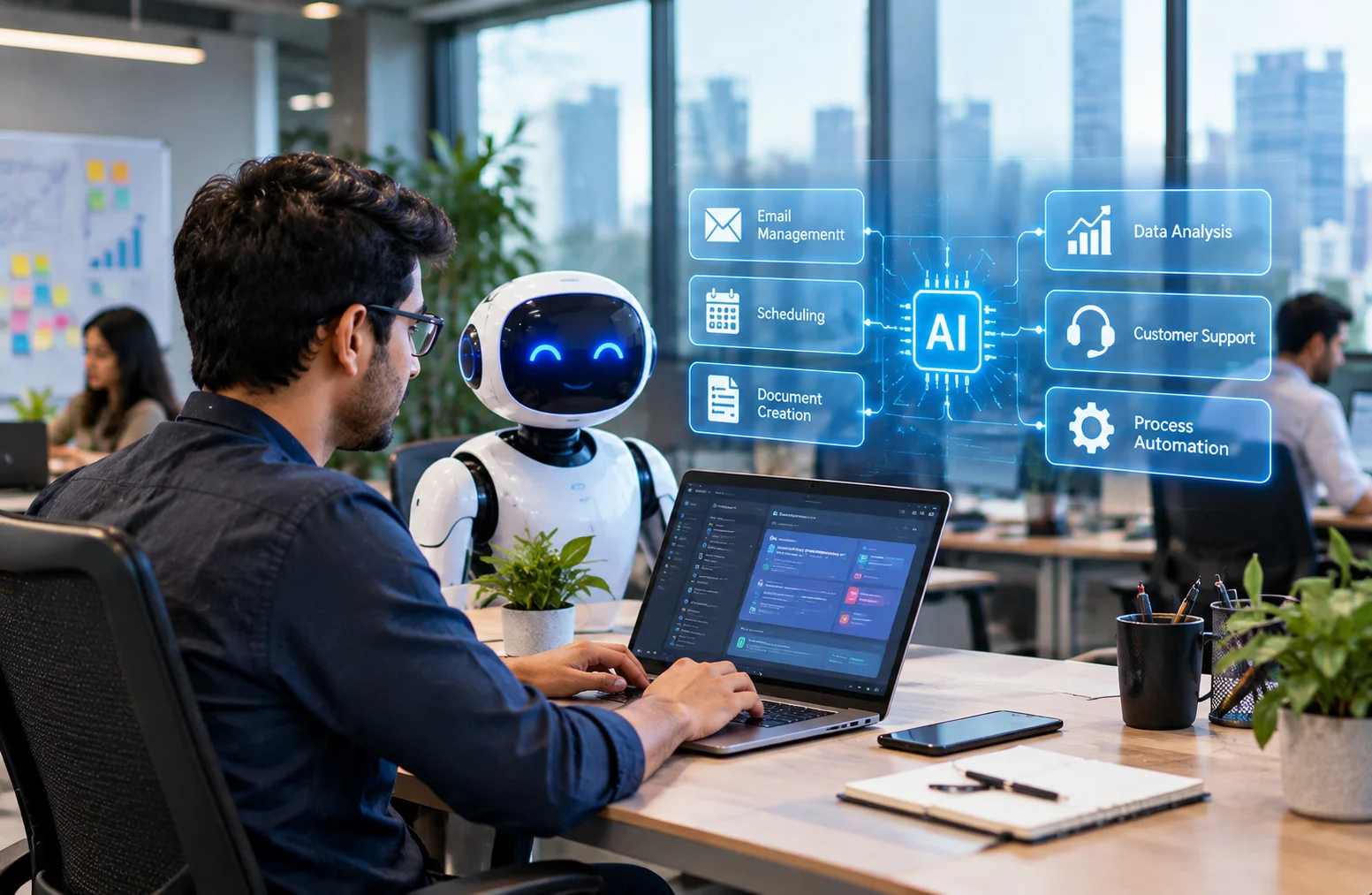
Employees often spend considerable time organising emails, scheduling meetings, updating records and preparing routine documents. AI agents can assist with these activities by sorting information, drafting responses, extracting relevant details and helping maintain business records.
When connected to approved workplace applications, they may also help coordinate multiple steps in a process. This can reduce manual effort and give employees more time to focus on work requiring judgement, creativity and personal communication.
2. Improving Customer Support
Customer service teams are exploring AI-powered systems that can answer common questions, summarise previous conversations and guide customers through standard procedures.
More advanced agents may help locate order information, check internal policies or prepare a response based on a customer’s request. Complicated complaints, sensitive matters and unusual situations should still be directed to qualified human staff.
The objective is not simply to handle more conversations automatically. Businesses also need to ensure that responses are accurate, helpful and consistent with their service standards.
3. Supporting Research and Data Analysis
AI agents can help workers collect information from approved sources, organise findings, compare documents and produce preliminary summaries. In departments such as marketing, finance, operations and research, these capabilities may shorten the time needed to prepare initial reports.
Nevertheless, AI-generated findings can contain errors, incomplete information or misleading conclusions. Employees should verify important facts, calculations and sources before using the output for business decisions.
4. Connecting Different Business Applications
Many organisations use separate systems for communication, project management, customer relationships and financial operations. AI agents can potentially connect parts of these workflows when suitable integrations and permissions are available.
For instance, an agent might help turn a meeting summary into a list of proposed tasks, prepare updates for a project management platform and draft a follow-up message. The exact actions depend on the software, access permissions and safeguards established by the organisation.
This ability to coordinate work across applications is one reason businesses are paying increasing attention to AI agents rather than relying only on standalone AI assistants.
Will AI Agents Replace Human Employees?
The growing use of AI agents has raised questions about job security. Some tasks that previously required substantial manual effort may become faster or increasingly automated. However, the effect on employment will differ by industry, occupation and the way companies implement the technology.
In many workplaces, AI is more likely to change individual responsibilities than eliminate every role associated with a particular process. Employees may spend less time gathering information or producing routine drafts and more time reviewing results, solving complex problems, managing relationships and making decisions.
Some positions may face significant changes, while other roles could develop around AI supervision, workflow design, data quality, compliance and technology management. The overall employment impact will depend on business demand, productivity gains, investment decisions and the availability of suitable training.
Workers who learn to use AI tools effectively may be better prepared for changing expectations, although technical knowledge alone will not replace the need for sound judgement and professional expertise.
Why Businesses Are Investing in AI Automation
Companies are interested in AI agents because they offer the potential to streamline processes, reduce repetitive work and help teams manage large volumes of information.
Potential benefits include:
- Faster workflows: Routine steps may take less time when suitable tasks are automated.
- More consistent processes: Standard instructions can help teams follow repeatable procedures.
- Better access to information: AI systems can help employees locate and summarise relevant material.
- Employee productivity: Workers may be able to devote more attention to complex and higher-value responsibilities.
- Workflow coordination: Connected tools can help manage several related activities within a single process.
These benefits are not guaranteed. Poor implementation, unreliable outputs, expensive integrations or inadequate employee training can reduce the value of an AI project. Businesses need to measure actual results rather than assuming that introducing AI automatically improves productivity.
Risks and Challenges of Workplace Automation
Despite their potential, AI agents introduce risks that companies must address before giving them access to important systems.
Incorrect outputs: An agent may misunderstand an instruction, use outdated information or produce a misleading result.
Data privacy: Connecting AI systems to internal documents or customer records can create risks if access controls are weak.
Security threats: Excessive permissions or poorly designed integrations may allow an agent to take actions beyond its intended purpose.
Accountability: Organisations need clear rules about who approves decisions and who is responsible when an automated process goes wrong.
Employee training: Staff members need to understand both the capabilities and the limitations of the tools they use.
To manage these concerns, businesses should begin with clearly defined tasks, restrict system permissions, maintain activity logs and require human approval for sensitive actions such as financial transactions, employment decisions or changes to confidential records.
The Skills Employees Will Need in an AI-Driven Workplace
As workplace automation develops, employees will benefit from combining digital skills with human abilities that are difficult to reduce to a fixed process.
Useful skills include writing clear instructions, checking AI-generated information, understanding basic data privacy, identifying errors and evaluating whether a proposed action makes sense in context.
Communication, problem-solving, leadership and critical thinking will remain important. Employees who understand their field and can assess AI output may be particularly valuable because they can recognise when a result is incomplete, inaccurate or unsuitable.
Businesses also have a role to play by providing practical training and creating clear guidelines for the responsible use of AI systems.
What the Future of Workplace Automation May Look Like
AI agents are likely to become more closely integrated with business software as companies develop safer and more reliable ways to automate connected tasks. Rather than handing over every responsibility to AI, many organisations may adopt a model in which automated systems handle routine steps while employees supervise outcomes and make important decisions.
The pace of adoption will vary. Organisations must consider the quality of their data, existing technology, operating costs, security requirements and the consequences of mistakes before expanding automation.
The most effective approach is likely to be selective implementation: identify repetitive processes, test AI agents on a limited scale, measure their performance and expand their responsibilities only when the results justify it.
Conclusion
AI agents are opening a new chapter in workplace automation by helping businesses coordinate tasks, process information and reduce some forms of repetitive work. Their capabilities could reshape office operations and change the skills employers expect from their teams.
However, successful adoption will depend on more than technology. Accuracy, security, employee training and human oversight will be essential to achieving meaningful results. Companies that balance automation with responsible decision-making will be better positioned to use AI agents as practical workplace tools.
As this technology continues to evolve, the central question for businesses will not simply be how much work AI can perform, but how people and AI systems can work together safely and effectively.