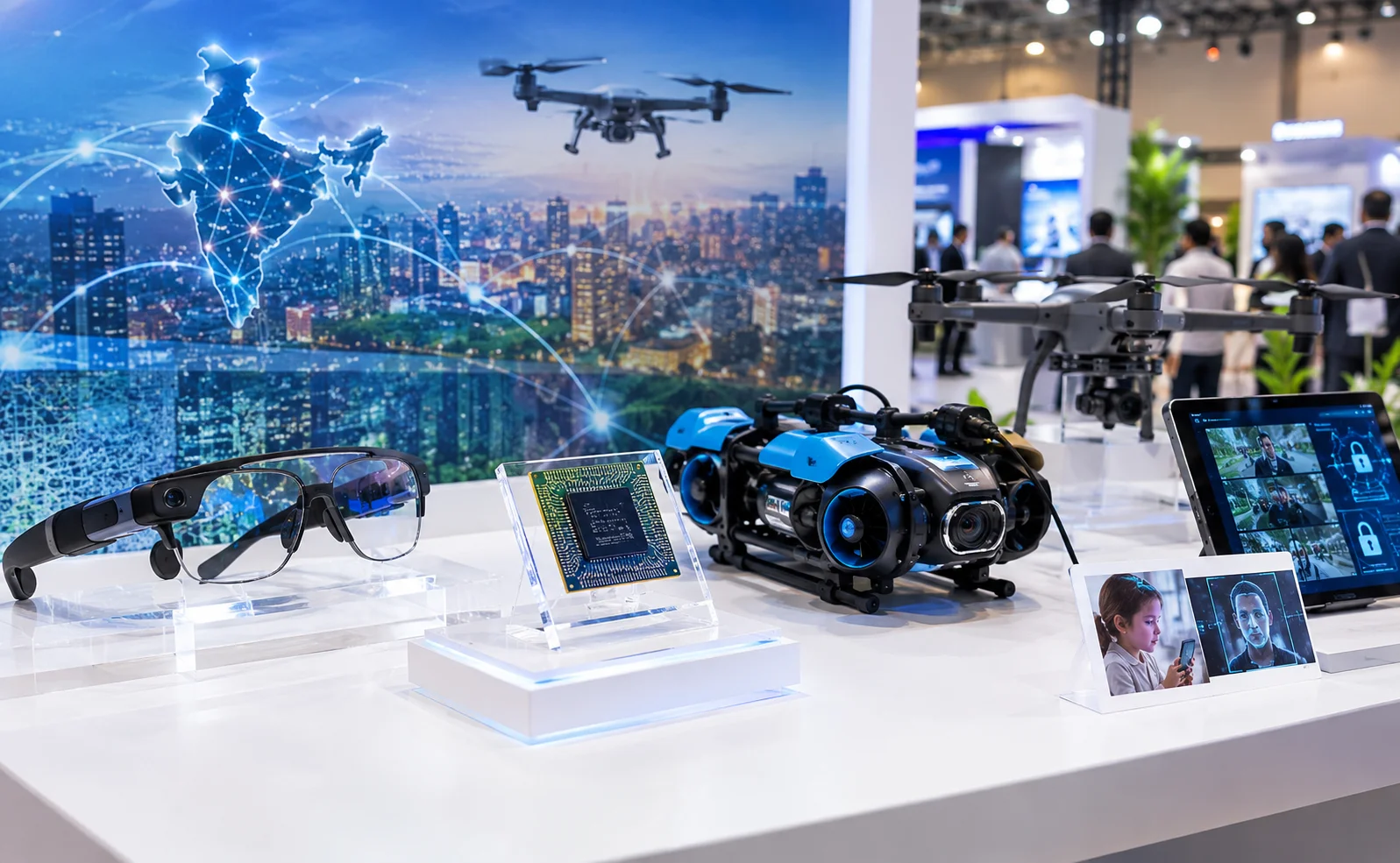
India is advancing its ambition to become a global technology leader through homegrown chips, AI-powered smart glasses, intelligent drone systems and next-generation cybersecurity solutions. A newspaper report from the India Mobile Congress highlights emerging technologies designed to support everyday activities, improve industrial efficiency and strengthen the country’s digital infrastructure.
India’s technology ecosystem is entering a new phase, with domestic innovators working on solutions that combine artificial intelligence (AI), telecommunications, semiconductor technology, robotics and digital security. These developments aim to make technology more accessible while reducing dependence on foreign products and strengthening India’s ability to develop and manufacture its own advanced systems.
According to the newspaper report, several emerging technologies showcased around the India Mobile Congress focus on practical applications, including agricultural assistance, safer industrial operations, drone management, child protection online and secure communications.
The report also highlights an ambitious long-term objective: developing 50 Indian technology brands with annual revenues exceeding ₹1 lakh crore each by 2047.
1. AI Smart Glasses Aim to Make Everyday Life Easier
AI-powered smart glasses are among the emerging technologies highlighted in the report. These devices are designed to combine wearable hardware with artificial intelligence to provide users with information about their surroundings.
Depending on their sensors, software and connectivity, AI glasses can potentially recognise objects, identify colours, interpret visible text and provide contextual assistance through audio or other interfaces.
Such capabilities could be particularly useful for people who need assistance understanding their surroundings, as well as professionals who require hands-free access to information.
Potential applications include:
- Accessibility: Helping users understand visual information and navigate everyday environments.
- Education and training: Providing contextual information while a person performs a task.
- Remote assistance: Allowing technicians or other professionals to receive guidance while working.
- Connected services: Using internet connectivity to access AI features and updated information.
The newspaper report also discusses the potential role of connected learning and agricultural advice through AI-enabled platforms. These applications could help farmers access information about crops and make more informed decisions.
However, the actual capabilities of individual smart-glasses products depend on their specifications, available software and network connectivity.
2. AI-Enabled Battery Technology for Safer Operations
Another technology discussed in the clipping concerns battery systems designed for challenging environments, including underwater operations.
The report refers to battery-related safety technology associated with marine applications. Such systems are important because equipment operating underwater or in industrial environments may face risks from water ingress, collisions, debris and changing operating conditions.
AI-based monitoring can potentially help analyse sensor readings, identify abnormal operating conditions and alert operators when a system requires attention.
Battery monitoring technologies may also help assess operating temperature, electrical performance and other parameters associated with safe operation.
Potential benefits include:
- Early identification of abnormal battery conditions.
- Improved monitoring of equipment operating in difficult environments.
- Alerts that help operators respond to potential safety issues.
- Better reliability for specialised marine and industrial equipment.
These applications illustrate how intelligent monitoring systems can support safety in environments where equipment failure may be costly or dangerous.
The precise product specifications and performance claims associated with the battery technology mentioned in the newspaper clipping were not fully legible, so they require confirmation from the original exhibitor or manufacturer.
3. Indigenous 64-Bit Chips Could Strengthen Data Security
Domestic semiconductor development is another important part of India’s technology ambitions.
The newspaper report highlights an indigenous 64-bit chip and discusses the role of locally developed processing technology in applications involving artificial intelligence, the Internet of Things (IoT) and telecommunications.
Semiconductors are essential components of smartphones, computers, connected devices, industrial systems and communications infrastructure. Developing domestic chip-design capabilities can help Indian companies build greater technical expertise and create products tailored to local requirements.
A system-on-chip (SoC) integrates multiple computing and control functions into a single semiconductor package. Depending on its architecture, it may support processing, communications, security and other functions.
Potential applications of indigenous chip technology include:
- Telecommunications: Supporting equipment used in connected networks.
- IoT devices: Enabling connected sensors and intelligent monitoring systems.
- Industrial applications: Processing information from machines and control systems.
- Security-sensitive systems: Supporting locally designed hardware and software architectures.
The report suggests that domestic chip technology could contribute to data protection and more secure telecommunications infrastructure.
However, the use of an Indian-designed chip does not automatically guarantee cybersecurity. Security also depends on the chip’s architecture, manufacturing integrity, firmware, software updates and the overall system in which it operates.
4. One Console Could Manage More Than 1,000 Drones
Drone technology is expanding across industries, including agriculture, infrastructure inspection, logistics and surveillance.
According to the newspaper clipping, a drone-management system showcased in the report is designed to control more than 1,000 drones through a single console.
Such a system could help operators coordinate large numbers of unmanned aerial vehicles through centralised software, subject to the platform’s technical capabilities and operational restrictions.
Managing multiple drones can involve flight planning, monitoring locations, assigning tasks, coordinating routes and tracking operational status. A centralised interface may make these activities easier to organise.
Potential uses include:
- Agriculture: Crop monitoring, field surveys and selected precision-farming tasks.
- Infrastructure: Inspecting large sites, power lines and industrial facilities.
- Emergency response: Supporting surveys of affected areas when conditions permit.
- Industrial operations: Coordinating drone-based inspections and data collection.
In agriculture, drones equipped with suitable cameras or sensors can help gather information about crop conditions. This data may assist farmers and agricultural specialists in identifying areas that require further inspection.
Nevertheless, managing a large drone fleet involves significant technical and regulatory challenges. Communications reliability, collision avoidance, battery life, operator supervision and aviation rules remain essential considerations.
The specific capabilities of the drone platform described in the clipping should be confirmed with its manufacturer.
5. AI-Based Monitoring and Cybersecurity Take Centre Stage
The newspaper report also highlights technology focused on monitoring safety-related conditions and strengthening digital protection.
AI-enabled monitoring systems can analyse information from sensors or connected devices to identify unusual patterns. In appropriate settings, this may help detect operational problems, changes in equipment behaviour or situations that require human attention.
The clipping mentions monitoring-related technology associated with fatigue or reduced attention, although the precise product name and full feature list are not clearly readable.
Such systems may be relevant to workplaces where alertness and safety are important, including industrial operations and transportation. Their effectiveness depends on the quality of their sensors, the reliability of their algorithms and appropriate human oversight.
Cybersecurity is equally important as more devices become connected to digital networks.
AI-assisted security systems can help identify unusual network activity, analyse potential threats and support faster investigation. However, automated systems may also produce false alarms or miss unfamiliar threats, making expert oversight and regular updates necessary.
India’s efforts to develop domestic digital-security technologies could contribute to the protection of critical infrastructure, business networks and connected services.
6. AI Tools Could Help Protect Children Online
Online safety for children is another area of technology highlighted in the newspaper clipping.
AI-powered content-moderation and filtering systems can help identify potentially harmful material, detect suspicious patterns and support safer digital experiences.
Depending on their design, these tools may help parents, educators and online platforms manage children’s exposure to inappropriate content.
Possible capabilities include:
- Detecting content that violates a platform’s child-safety policies.
- Identifying potentially harmful or suspicious online interactions.
- Supporting age-appropriate content filtering.
- Alerting parents or administrators to certain risks.
However, AI cannot identify every online threat or replace responsible supervision. Effective child protection also requires privacy safeguards, clear reporting mechanisms, age-appropriate education and responsible platform policies.
The exact product and technical features referred to in the newspaper report should be verified before making more specific claims.
7. India Targets 50 Major Homegrown Technology Brands by 2047
One of the most significant points in the newspaper clipping is its discussion of India’s long-term technology ambitions.
According to the report, an industry document referred to as the Developed Tech Report 2047 was presented at the India Mobile Congress. The clipping states that the report identified 129 Indian brands across fields including AI, cybersecurity, space technology, electronics and connected cars.
It attributes combined annual business activity of more than ₹60,000 crore to these brands and gives an average revenue figure of approximately ₹465 crore per brand.
The clipping also reports that only 14 brands had revenues above ₹500 crore, highlighting the challenge of building more large-scale domestic technology businesses.
These figures are attributed to the newspaper report and have not been independently verified against the original document.
The report further cites electronics production of approximately ₹13.11 lakh crore, while suggesting that the share attributable to domestic brands remains relatively limited.
The long-term goal described in the clipping is to develop 50 homegrown technology brands with annual revenue exceeding ₹1 lakh crore each by 2047.
Achieving this target would require sustained investment, product innovation, strong intellectual-property capabilities, access to global markets and the ability to compete with established international companies.
It would also require a broader ecosystem of semiconductor suppliers, manufacturers, software developers, research institutions and skilled professionals.
Why Indigenous Technology Matters for India’s Future
The development of homegrown technology can offer several strategic advantages.
Greater technological capability: Domestic research and product development can help Indian companies build expertise in advanced fields.
Improved supply-chain resilience: Local design and manufacturing capabilities can reduce exposure to certain external supply disruptions, although complete independence is difficult to achieve.
New business opportunities: Emerging technology sectors can create opportunities for startups, suppliers and established manufacturers.
Specialised local solutions: Indian companies can develop products designed for local industries, languages, operating conditions and consumer requirements.
Potential export growth: Competitive domestic products may find customers in international markets and strengthen India’s position in global technology supply chains.
At the same time, local development alone is not enough. Products must demonstrate reliability, competitive pricing, strong security and long-term commercial value to succeed in India and abroad.
Challenges Facing India’s Technology Ecosystem
Despite the progress described in the report, several challenges remain.
Semiconductor development requires significant investment, specialised engineering talent and access to sophisticated manufacturing facilities. AI products require reliable data, computing infrastructure and careful evaluation. Drone fleets need dependable communications and compliance with aviation regulations.
Cybersecurity solutions must also be continuously updated as threats evolve. In addition, companies need to build consumer trust, protect intellectual property and establish sustainable business models.
For domestic technology brands to become global leaders, innovation must be matched by high-quality manufacturing, effective commercialisation and the ability to compete internationally.
Conclusion
The technologies highlighted in the India Mobile Congress newspaper report demonstrate the breadth of India’s ambitions across AI, semiconductors, drone management, connected devices and cybersecurity.
From smart glasses that can provide contextual assistance to locally developed chips and large-scale drone-management systems, these innovations aim to address practical challenges while strengthening domestic technology capabilities.
The reported goal of building 50 Indian technology brands with annual revenues exceeding ₹1 lakh crore each by 2047 reflects a broader ambition to move beyond technology adoption towards developing globally competitive products and companies.
Whether these ambitions are achieved will depend on continued research, investment, product reliability, skilled talent and successful commercial execution.
As India continues to develop its digital and manufacturing ecosystem, homegrown innovation could become an increasingly important part of its economic growth and global technology presence.
Source note: This article is based on the newspaper clipping provided. Several product names and technical details are not fully legible in the image. The report’s statistics and the stated 2047 target should be checked against the original India Mobile Congress presentation or industry report before publication.