Artificial intelligence is beginning to reshape the way companies organize their daily operations, manage employees, and distribute responsibilities. One of the most significant changes is the growing role of AI agents in handling administrative tasks, allowing managers to focus more on decision-making, team performance, and business strategy.
Unlike traditional software that follows a fixed set of instructions, AI agents can be designed to complete multi-step tasks, analyze information, coordinate workflows, and assist with routine business processes. As these capabilities develop, organizations are exploring new ways to integrate AI into everyday office operations.
AI Agents Are Transforming Routine Office Work
Administrative work has traditionally consumed a considerable portion of employees’ time. Activities such as preparing reports, scheduling meetings, organizing documents, summarizing emails, updating records, and tracking project progress can slow down other important responsibilities.
AI-powered agents can help automate parts of these processes. Depending on their design and the permissions they receive, they may gather information from different sources, prepare summaries, draft communications, and support task coordination.
This does not mean every administrative position will disappear. Instead, many organizations may redesign existing roles so that employees spend less time on repetitive activities and more time on work that requires judgment, creativity, communication, and problem-solving.
The benefits will depend on how effectively companies implement these systems and whether their employees receive the necessary training.
Managers Could Become the Main Supervisors of AI Agents
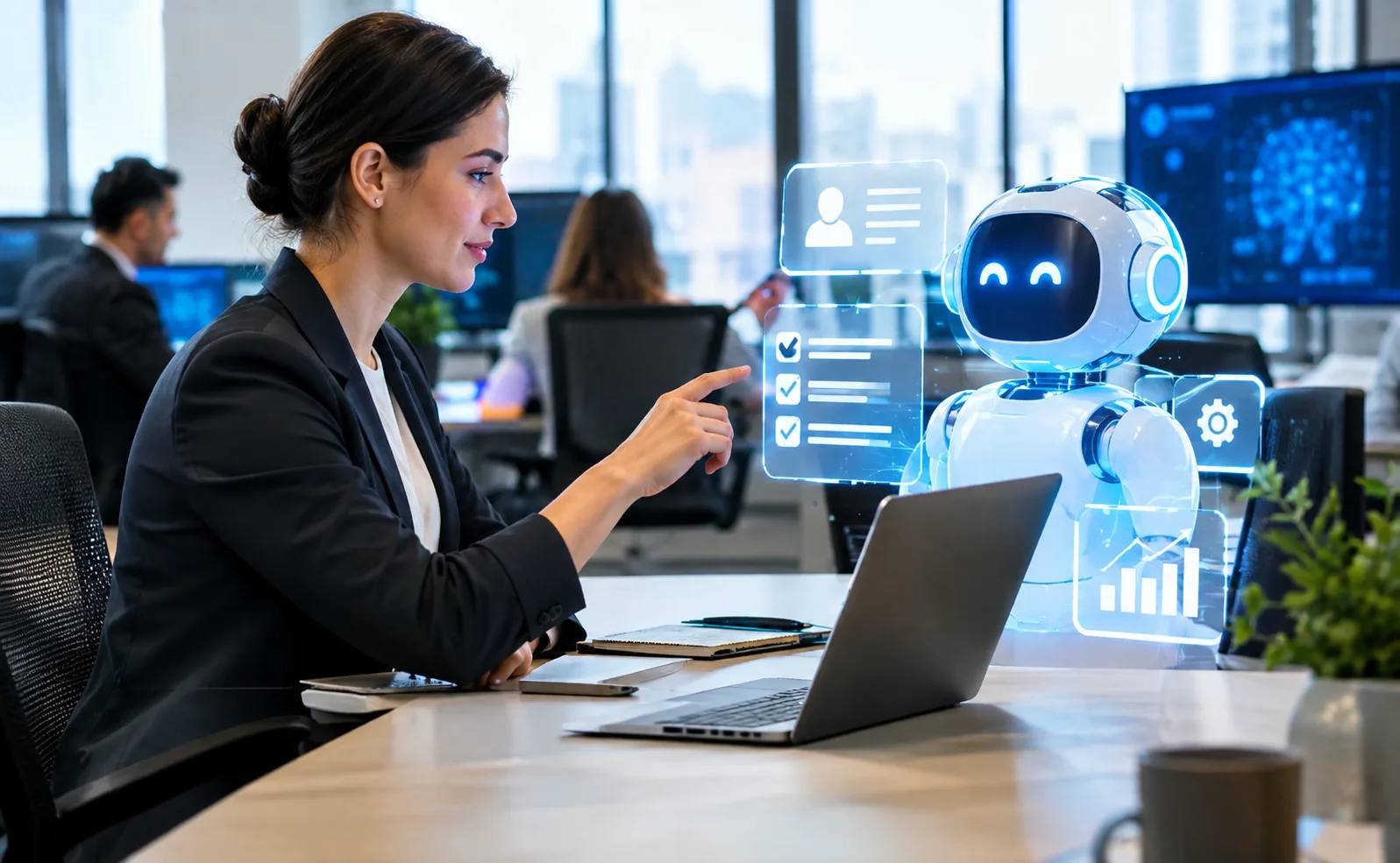
As AI agents become more integrated into business operations, managers may take on a new responsibility: overseeing digital workers alongside human employees.
Their role could involve assigning tasks to AI systems, defining performance expectations, reviewing results, and ensuring that automated processes follow company policies. Managers may also need to decide which activities can be safely delegated to AI and which require human approval.
For example, an AI agent might prepare a weekly performance report, organize project updates, or draft a customer response. A manager could then review the information, correct errors, and approve the final output before it reaches the intended audience.
This approach places human supervision at the center of AI adoption. Rather than allowing automation to operate without oversight, businesses can establish clear responsibilities and checkpoints for important decisions.
How Administrative Responsibilities May Change
The expansion of AI agents could lead to a different distribution of work across corporate teams.
Employees who previously spent hours completing routine documentation may be able to concentrate on customer relationships, planning, and more complex assignments. Team leaders could gain additional time to coach employees, resolve operational problems, and improve productivity.
Human resources departments may use AI tools to support document preparation, onboarding coordination, and internal information requests. Finance teams could apply them to preliminary data organization and report preparation, while marketing departments may use AI to assist with research, content planning, and campaign analysis.
However, these examples represent potential applications rather than guaranteed outcomes. Accuracy, system integration, data quality, and the complexity of each task will influence how much work can realistically be automated.
Productivity Gains Will Depend on Human Oversight
Although AI agents offer opportunities to improve efficiency, businesses should not assume that automation will automatically deliver better results.
AI systems can generate inaccurate information, misunderstand instructions, or take inappropriate actions when they operate with insufficient context. Errors may become more serious when an agent can access sensitive company records, communicate externally, or make changes to business systems.
Companies therefore need clear rules covering access permissions, approval requirements, data protection, and accountability. Sensitive activities involving financial commitments, employment decisions, legal obligations, or confidential information may require additional human review.
Managers will need to understand not only what AI tools can do but also where their limitations begin. Effective supervision will involve checking the quality of outputs, monitoring performance, and intervening when systems produce unreliable results.
Employees Will Need New Skills in the AI Workplace
The changing role of AI in corporate operations could increase demand for skills that combine technical understanding with human judgment.
Employees may need to learn how to give precise instructions to AI systems, evaluate generated information, identify mistakes, and manage automated workflows. Communication, critical thinking, adaptability, and problem-solving will remain important as responsibilities evolve.
Managers may also require training in AI governance, risk assessment, workflow design, and performance evaluation. Their success will depend on balancing automation with employee development and maintaining clear lines of accountability.
Organizations that introduce AI without preparing their workforce could face confusion, resistance, and inconsistent results. Training and transparent communication can help employees understand how these technologies affect their responsibilities and where human expertise remains essential.
Data Security and Accountability Remain Major Concerns
Giving AI agents access to corporate systems introduces important security and privacy considerations. An agent that handles emails, internal documents, customer information, or financial records must operate within carefully defined boundaries.
Businesses should apply the principle of least privilege, granting AI systems only the access required for their assigned tasks. They should also maintain appropriate monitoring, review important actions, and establish procedures for responding to mistakes or unauthorized activity.
Clear accountability is equally important. Organizations need to determine who is responsible when an AI agent produces incorrect work or completes an action that causes problems. Assigning a task to an automated system should not remove the need for responsible human supervision.
The Future of Corporate Management
The growing use of AI agents could gradually change the definition of effective management. Instead of spending most of their time tracking routine activities and checking administrative details, managers may increasingly focus on coordinating people and technology, setting priorities, and evaluating outcomes.
This transition is unlikely to happen at the same speed across every industry. Companies with well-organized digital systems and clearly defined workflows may find it easier to introduce AI agents, while businesses with complex processes or strict regulatory requirements may need a more cautious approach.
The long-term impact will depend on how organizations combine automation with human expertise. AI agents can support faster workflows and reduce repetitive effort, but their value will ultimately be measured by the quality, reliability, and usefulness of the work they help produce.
Conclusion
Corporate workplaces are entering a period of change as AI agents take on a growing share of routine administrative activities. Managers may increasingly become responsible for directing these systems, checking their work, and ensuring that automation supports business objectives without compromising security or accountability.
Rather than viewing AI solely as a replacement for existing jobs, organizations can approach it as a tool for redesigning workflows and helping employees focus on higher-value responsibilities. Companies that combine effective AI implementation with strong human oversight and workforce training will be better positioned to adapt to the evolving workplace.