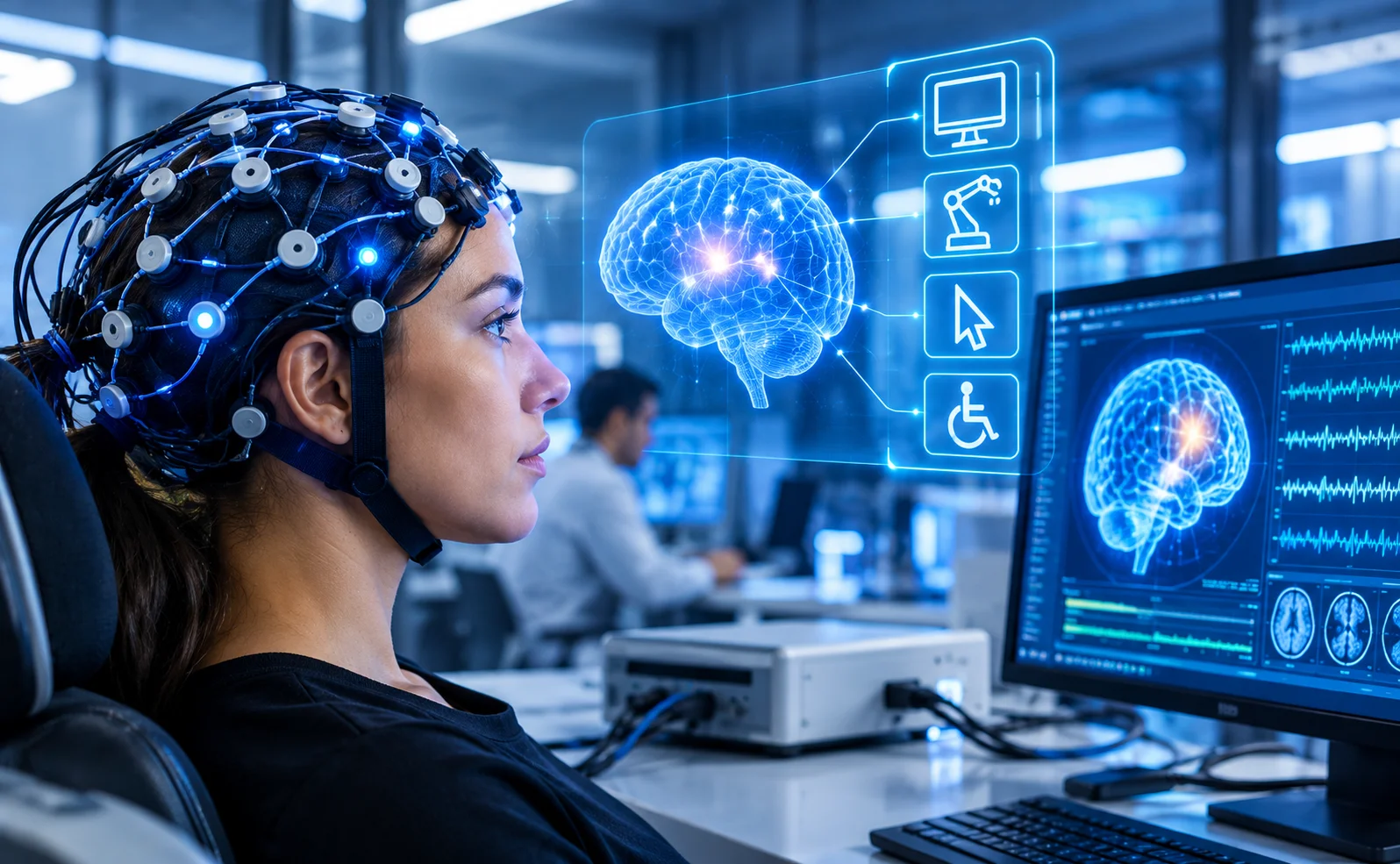
Researchers and technology teams are continuing to explore a rapidly developing field known as brain-computer interfaces (BCIs). These experimental systems are designed to create a communication pathway between brain activity and digital devices, potentially allowing certain computer functions to be controlled through neural signals.
Although the technology remains largely experimental, recent research has increased interest in how brain signals could eventually be translated into useful digital commands. Scientists are investigating applications ranging from assistive communication to rehabilitation and new forms of human-computer interaction.
What Is a Brain-Computer Interface?
A brain-computer interface is a technology that attempts to interpret patterns of brain activity and convert them into commands that a computer or another electronic system can understand.
Traditional computers require physical input such as a keyboard, touchscreen, mouse, or voice command. A BCI takes a different approach by attempting to detect neural activity associated with particular intentions and translating those signals into digital instructions.
Depending on the design, a BCI may use sensors positioned outside the body or technologies that detect neural activity more directly. Researchers are studying both approaches while working to improve accuracy, reliability, safety, and ease of use.
How BCI Prototypes Work
At a basic level, a brain-computer interface involves several stages.
First, sensors collect neural activity. The system then processes those signals using specialized software and attempts to identify meaningful patterns. Machine-learning techniques can be used to distinguish different signal patterns and associate them with specific commands.
For example, researchers may train a system to recognize neural activity associated with an intended movement. The resulting signal could potentially be translated into a computer command or assistive-device movement.
The process is technically challenging because brain signals can be extremely complex and can vary between individuals and even across different sessions for the same person.
Why Researchers Are Interested in the Technology
One of the most important areas of BCI research is assistive technology.
Scientists are investigating whether these systems could eventually help people who have difficulty using conventional communication or control devices. A successful interface could potentially provide another method for interacting with computers, communication systems, or specialized equipment.
Researchers are also examining possible applications in rehabilitation. Brain-computer interfaces may help scientists better understand the relationship between neural activity and physical movement, potentially supporting the development of new rehabilitation technologies.
These possibilities remain areas of active research rather than guaranteed future applications.
The Role of Artificial Intelligence
Artificial intelligence and machine learning are becoming increasingly important in BCI research.
Neural signals can contain complicated patterns that are difficult to interpret using simple rule-based software. Machine-learning models can analyze large quantities of signal data and identify patterns that may correspond to particular intended actions.
Researchers can then refine these models as additional data becomes available.
However, accuracy remains an important challenge. A system that works well under controlled laboratory conditions may behave differently when circumstances change. Movement, environmental interference, sensor placement, and variations in neural activity can all affect performance.
Non-Invasive and Implanted Approaches
BCI research includes several different technological approaches.
Non-invasive systems use sensors placed outside the body to detect brain activity. These systems generally avoid surgical procedures, but the signals they capture can be weaker and more difficult to interpret.
Implanted systems use devices positioned closer to neural tissue. Because these systems can potentially obtain more detailed neural signals, researchers are investigating whether they can provide more precise control.
Each approach involves different technical considerations, including signal quality, reliability, maintenance, safety, and long-term usability.
Major Challenges Facing Brain-Computer Interfaces
Despite significant scientific interest, BCIs face numerous challenges before they can become widely used.
One major challenge is signal interpretation. The brain produces enormous amounts of activity, and distinguishing useful signals from background activity is difficult.
Another challenge is consistency. Neural signals can change over time, meaning that a system may need calibration or adaptation.
Researchers must also consider privacy and security. Brain-computer interfaces could potentially process highly sensitive neurological information, making responsible data handling an important part of future development.
There are also questions surrounding affordability, accessibility, long-term reliability, and the practical requirements of using these systems outside research environments.
Privacy Could Become a Major Issue
As BCI technology develops, privacy discussions may become increasingly important.
Traditional digital services already collect significant amounts of personal information. Neural interfaces introduce a potentially more sensitive category of information because they interact with signals generated by the brain.
Researchers, companies, regulators, and policymakers may therefore need to consider how neural data should be collected, stored, processed, and protected.
Questions surrounding user consent and control over neural information could become particularly important as the technology moves from laboratory experiments toward practical applications.
What Could the Future Look Like?
The long-term future of brain-computer interfaces remains uncertain, but research continues to expand across neuroscience, medicine, artificial intelligence, robotics, and computer science.
Future systems could become smaller, more efficient, and better at interpreting neural signals. Improvements in sensors and machine-learning algorithms could also make interfaces more responsive and easier to operate.
However, progress will likely depend not only on technical breakthroughs but also on safety research, ethical frameworks, privacy protections, regulatory standards, and real-world testing.
Industry Interest Continues to Grow
BCI development is attracting attention because it sits at the intersection of several rapidly advancing technologies.
Artificial intelligence can assist with signal processing, advanced sensors can improve data collection, and robotics can provide physical systems that respond to neural commands.
This combination creates opportunities for researchers to explore entirely new approaches to human-computer interaction.
At the same time, the industry will need to distinguish between experimental demonstrations and technologies that have been independently validated for reliable everyday use.
The Road Ahead
Brain-computer interfaces remain an emerging technology, but ongoing research is helping scientists better understand how neural signals can interact with digital systems.
The next phase of development will likely focus on improving accuracy, reducing complexity, increasing reliability, and addressing safety and privacy concerns.
Whether BCIs eventually become a common form of computer interaction or remain specialized technologies for particular applications is still uncertain. For now, researchers continue testing prototypes and exploring what is technically and practically possible.
Final Thoughts
Brain-computer interface research represents an ambitious attempt to create a new communication channel between the human brain and digital technology.
While many potential applications are still experimental, advances in sensors, artificial intelligence, neuroscience, and computing are helping researchers push the field forward.
The technology could eventually influence assistive devices, rehabilitation, communication, robotics, and other areas of computing. At the same time, its development will require careful attention to safety, privacy, security, accessibility, and responsible use.
As researchers continue testing new BCI prototypes, the field offers a fascinating glimpse into how the relationship between humans and computers could evolve in the years ahead.