Virtual reality gaming is moving beyond the traditional idea of playing alone inside a digital environment. Improvements in VR hardware, wireless connectivity, game engines, motion tracking, and online multiplayer technology are creating increasingly immersive experiences in which players can interact with friends and other gamers in shared virtual spaces.
What once required expensive equipment and complicated setups is gradually becoming more accessible. At the same time, developers are experimenting with new multiplayer mechanics that allow players to communicate, cooperate, compete, explore, and participate in virtual events together.
Multiplayer Becomes a Central Part of VR Gaming
Early virtual reality experiences often focused heavily on single-player exploration and demonstrations of immersive environments. Modern VR development is increasingly focused on social interaction.
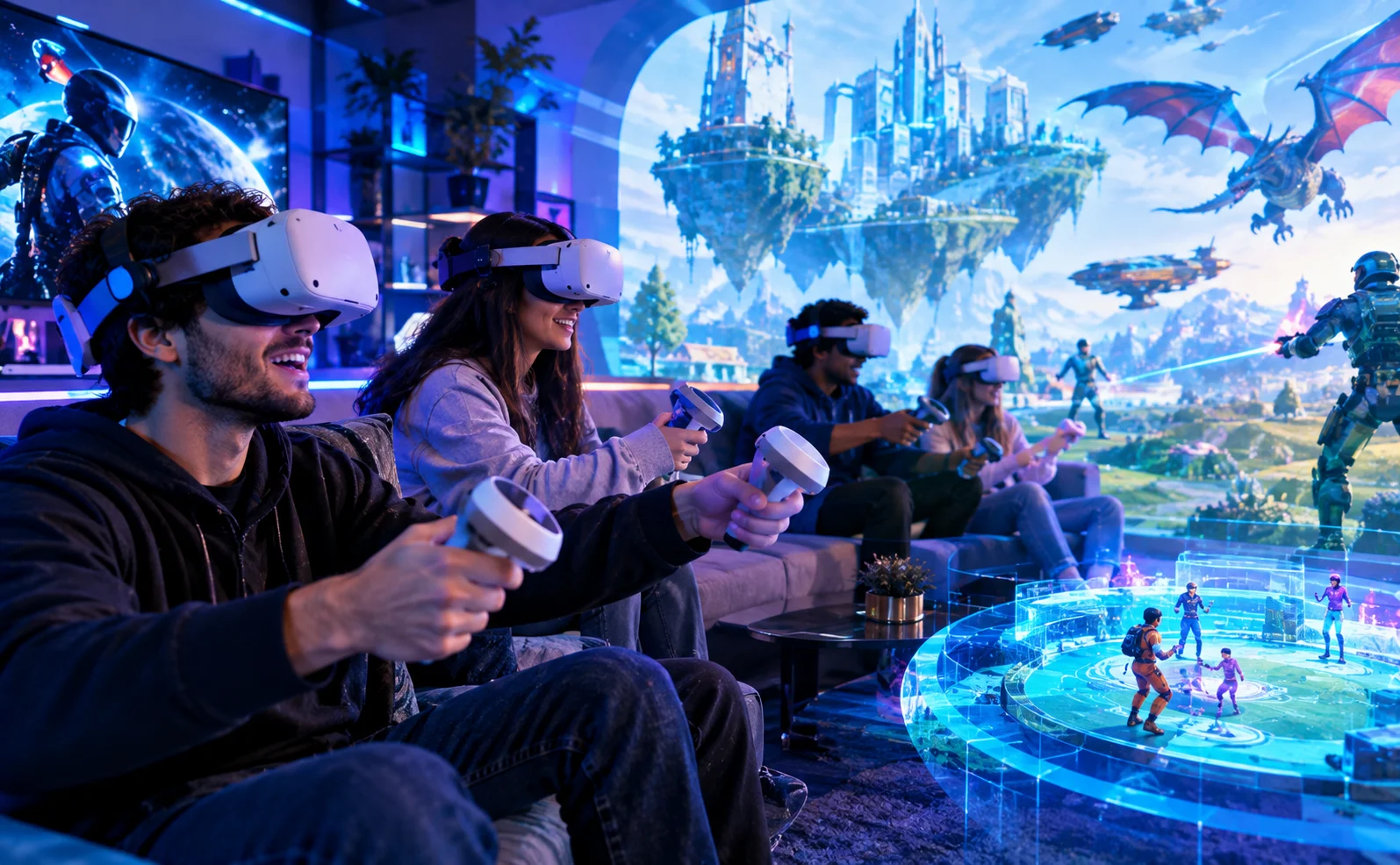
Multiplayer VR games can allow several participants to enter the same digital environment and interact with one another in real time.
Players may be able to:
- Explore virtual worlds together
- Complete cooperative missions
- Compete in multiplayer matches
- Communicate through voice chat
- Use hand and body movements
- Build or customize virtual environments
- Participate in social activities
- Attend virtual events
These features make VR gaming feel less like interacting with a screen and more like sharing a digital space with other people.
Real-Time Interaction Creates New Possibilities
One of the defining characteristics of multiplayer VR is the ability to see other players represented inside the virtual environment.
Instead of simply seeing an online username, players may see an avatar moving, gesturing, pointing, or interacting with objects.
Hand tracking and motion controllers can make these interactions more expressive. A player can potentially wave to another participant, pick up an object, point toward something, or perform actions that become part of the gameplay.
Developers are increasingly designing game mechanics around these possibilities.
Cooperative Gameplay Is Becoming More Creative
VR can make cooperative gaming more interactive because players physically share the same virtual environment.
For example, one player might need to operate a control panel while another searches a virtual room for information. In another game, players could work together to solve puzzles, defend a location, explore an unfamiliar environment, or complete a mission.
These mechanics encourage communication and teamwork rather than simply requiring players to compete against one another.
The result can be a different type of multiplayer experience in which coordination becomes an important part of the gameplay.
Competitive VR Gaming Continues to Develop
Virtual reality is also being used for competitive multiplayer experiences.
Developers can create games involving virtual sports, racing, combat, strategy, rhythm challenges, and other competitive formats.
VR adds another layer to competition because players may need to manage physical movement as well as traditional gaming decisions.
Accuracy, timing, spatial awareness, and quick reactions can all become important elements depending on the game.
As developers gain more experience with VR design, competitive multiplayer formats are likely to become increasingly varied.
Better Hardware Is Supporting the Growth
Hardware improvements are an important part of VR’s development.
Modern headsets are becoming more capable while offering features such as improved displays, better tracking, wireless connectivity, and more comfortable designs.
Controllers are also becoming more sophisticated, while some systems support hand tracking that reduces the need for physical controllers in certain experiences.
These improvements can make virtual environments feel more responsive and reduce some of the technical barriers that affected earlier VR systems.
Wireless VR Changes the Experience
Wireless connectivity has become particularly important for virtual reality.
Traditional wired headsets can restrict movement because players need to remain connected to a computer or console through a cable. Wireless systems provide greater freedom to move around within the supported play area.
This is especially useful for multiplayer experiences involving physical movement.
Players can turn, walk, reach, and interact with their surroundings without constantly managing a cable.
However, wireless VR still depends on factors such as battery life, network quality, hardware performance, and connection stability.
Social VR Goes Beyond Traditional Games
Virtual reality multiplayer technology is also creating experiences that are not strictly traditional video games.
Virtual spaces can function as social environments where people meet, communicate, create content, attend events, or simply spend time together.
This has contributed to the development of social VR platforms and virtual communities.
For some users, the attraction is not winning a match but experiencing a sense of presence with other people in a shared digital environment.
Avatars Are Becoming More Expressive
Avatars play an important role in multiplayer VR because they represent users inside virtual environments.
Modern systems can use head and hand movements to control avatars, creating more natural interactions.
Developers are also experimenting with facial expressions, body tracking, customizable characters, and other technologies that can make virtual representations more expressive.
The long-term goal is to make communication inside virtual environments feel more natural.
AI Could Add Another Layer to Multiplayer VR
Artificial intelligence could significantly influence the future of virtual reality gaming.
AI systems can potentially support intelligent non-player characters, dynamic environments, automated assistance, personalized gameplay, and more responsive virtual worlds.
In multiplayer games, AI could also help generate challenges that adapt to different groups of players.
For example, a virtual environment could adjust its difficulty depending on how effectively a team is performing.
AI-generated content may also help developers create larger and more varied game environments, although questions surrounding quality, originality, copyright, and development practices remain important.
Cloud Technology Could Improve Multiplayer Experiences
Cloud computing may also play a role in the future of VR gaming.
Some computational tasks can potentially be handled by remote servers rather than entirely by the user’s local device. This could create opportunities for more complex virtual environments and multiplayer systems.
However, cloud-based VR requires reliable, low-latency internet connections. Delays between a player’s physical movement and the corresponding virtual response can negatively affect immersion and gameplay.
For this reason, network performance remains an important technical consideration.
Cross-Platform Multiplayer Could Expand Communities
Another important development is the possibility of connecting players across different devices.
A multiplayer VR ecosystem could potentially include users playing through different headsets, PCs, consoles, or other supported devices.
Cross-platform compatibility can help developers build larger communities because players are not restricted to a single hardware ecosystem.
However, supporting multiple platforms can also make development more complicated. Hardware capabilities, control systems, graphics performance, and software requirements may differ significantly between devices.
Developers Face New Design Challenges
Creating a successful VR multiplayer game requires more than simply converting a traditional game into virtual reality.
Developers must think about movement, camera control, player comfort, interaction design, communication, virtual spaces, and multiplayer synchronization.
Motion sickness is another consideration for some VR users. Developers therefore use different movement systems and comfort settings to accommodate varying player preferences.
Games also need to maintain stable performance because technical problems can become particularly noticeable in immersive environments.
Safety and Privacy Are Important
As VR becomes more social, privacy and user safety are becoming increasingly important.
Multiplayer environments can involve voice communication, user-generated content, avatars, and interactions with strangers.
Platforms therefore need systems that can help users manage unwanted interactions and report inappropriate behavior.
Privacy is another consideration because VR systems can potentially collect information related to movement, voice, interactions, and device usage.
Responsible handling of this information will remain important as immersive platforms become more sophisticated.
The Future of Multiplayer VR Gaming
The next generation of VR gaming is likely to become increasingly social, interactive, and connected.
Future experiences could combine advanced motion tracking, realistic environments, artificial intelligence, cloud computing, and large-scale multiplayer systems.
Developers may also experiment with persistent virtual worlds in which players can return regularly, build communities, customize spaces, and participate in evolving events.
The distinction between gaming, social interaction, entertainment, and virtual experiences could become less clearly defined as these technologies mature.
Conclusion
Virtual reality gaming is entering a new stage in which multiplayer interaction is becoming one of its most important areas of development. Improvements in hardware, wireless connectivity, motion tracking, artificial intelligence, and online infrastructure are giving developers new ways to create shared virtual experiences.
From cooperative adventures and competitive games to social environments and virtual events, multiplayer VR offers possibilities that extend well beyond traditional gaming.
Challenges involving hardware costs, connectivity, comfort, privacy, safety, and development complexity still need to be addressed. Nevertheless, continued innovation is making virtual reality increasingly capable of bringing players together in digital environments that feel more interactive and immersive than conventional gaming experiences.