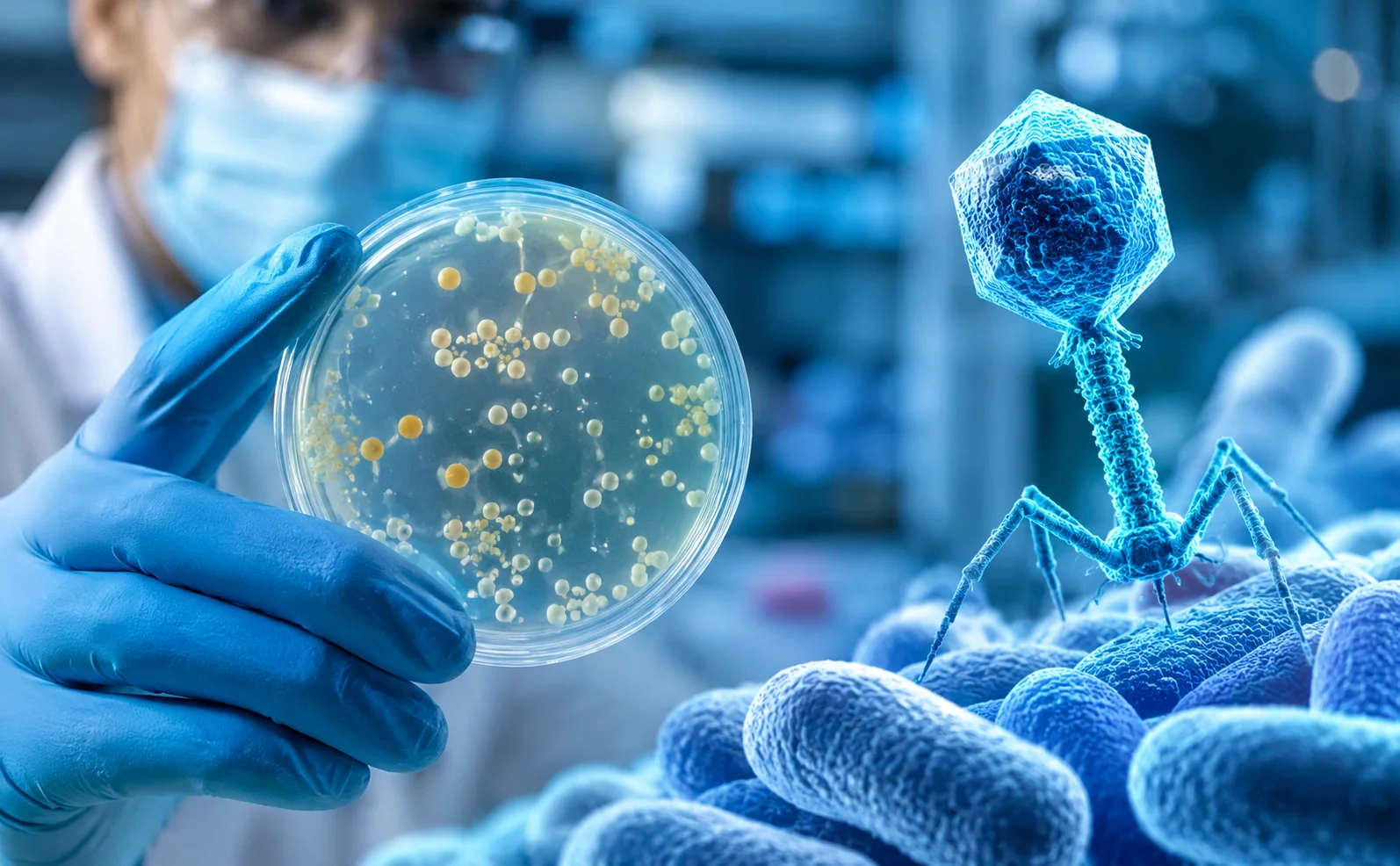
Artificial intelligence is opening a new frontier in biotechnology, with researchers exploring whether specially designed viruses can help fight bacterial infections that no longer respond to conventional antibiotics. A recent announcement from US biotechnology startup Radical Numerics has brought this emerging approach closer to clinical medicine, although its effectiveness in patients remains to be established.
Introduction: A New Approach to the Antibiotic Resistance Crisis
Antibiotics have transformed modern medicine, helping doctors treat infections that once posed a serious threat to human life. However, bacteria can develop resistance to medicines designed to eliminate them. When this happens, infections become more difficult to manage, and treatment options may become limited.
Scientists are now exploring different ways to tackle this growing challenge. One promising research direction involves bacteriophages, commonly known as phages. These naturally occurring viruses infect bacteria rather than human cells. Researchers are investigating how phages could be selected or engineered to target specific bacterial strains.
Artificial intelligence may help accelerate this process. Instead of relying entirely on traditional laboratory screening, researchers can use computational models to identify promising genetic designs and predict how a virus might interact with a particular bacterium.
In October 2026, Radical Numerics reported that phages designed with its AI system had been administered to a patient with an antibiotic-resistant bacterial infection under an authorized, physician-led treatment pathway. The announcement represents an early clinical milestone, not proof that the approach is already an effective treatment. Source: Radical Numerics
What Are Antibiotic-Resistant Bacteria?
Antibiotic resistance occurs when bacteria develop the ability to survive exposure to medicines that would ordinarily stop their growth or kill them. Resistance can emerge through genetic changes and spread between bacterial populations.
Several factors contribute to the problem, including inappropriate antibiotic use, incomplete adherence to prescribed treatment, inadequate infection prevention and the spread of resistant organisms in healthcare settings and communities.
The consequences can be serious. Some infections become harder to treat, require alternative medicines, or need prolonged medical care. Resistant bacteria are particularly concerning for people who are already seriously ill or whose immune systems are weakened.
Researchers are therefore investigating new antimicrobial approaches that work differently from conventional antibiotics. Phage-based treatments are one area attracting renewed scientific interest.
What Are Bacteriophages, and How Do They Work?
Bacteriophages are viruses that naturally infect bacteria. Different phages can target different bacterial species or strains, making them potentially useful for highly specific antimicrobial treatments.
In simplified terms, a suitable phage attaches to a compatible bacterial cell and delivers its genetic material. The virus then uses the bacterial cell’s machinery to produce more phages. Many phages eventually cause the infected bacterium to break apart, releasing newly formed viruses.
This targeted activity distinguishes phages from many conventional antibiotics, which may affect a broader range of bacteria.
However, phage therapy is not a universal solution. A phage that attacks one bacterial strain may be ineffective against another, even when both bacteria belong to the same species. Doctors and researchers must identify the pathogen and determine whether an appropriate phage can act against it.
This matching process is one reason personalized phage treatment can be difficult and time-consuming.
How Artificial Intelligence Could Improve Phage Research
AI models can analyze large amounts of biological information and identify patterns that may be difficult to detect through conventional analysis alone. In phage research, these systems can help scientists explore possible genetic sequences, estimate interactions between viruses and bacterial hosts, and prioritize candidates for laboratory testing.
Radical Numerics has developed an AI model called Omnii-1 for genome design and phage-host interaction research. According to the company’s October 2026 technical report, the system was used to generate and prioritize phage variants intended to target an antibiotic-resistant bacterial infection.
The broad idea is to combine computational design with laboratory verification. AI proposes candidates, while biological experiments determine whether those candidates are viable and demonstrate the desired activity.
It is important to understand that a computer-generated genetic design is not automatically a functioning or safe treatment. Experimental testing and medical oversight remain essential.
What Did Radical Numerics Announce?
Radical Numerics reported that AI-designed phage variants were included in a treatment administered to a patient with an antibiotic-resistant Escherichia coli infection.
The company said the treatment was provided through an authorized single-patient pathway under physician supervision. Its published report also described laboratory testing in which a mixture containing the designed phages eliminated the patient’s bacterial isolate under experimental conditions.
These findings are noteworthy, but their interpretation requires care.
Eliminating bacteria in a laboratory test does not necessarily mean the same treatment will clear an infection inside a human body. Conditions inside the body are more complex, and researchers must assess safety, dosing, biological activity and clinical outcomes.
The company has not publicly disclosed the patient’s clinical course or treatment outcome in its report, citing privacy considerations. Consequently, the announcement should not be interpreted as confirmation that the patient recovered or that the treatment has been proven effective.
The company’s findings are also not the same as independently replicated results published in a peer-reviewed medical journal. Further evidence will be needed to establish the approach’s clinical value.
AI-Designed Phages vs. Conventional Antibiotics
| Feature |
Conventional antibiotics |
AI-assisted phage therapy |
| Treatment approach |
Uses medicines that inhibit or kill susceptible bacteria |
Uses selected or engineered viruses that target bacteria |
| Targeting |
Depends on the antibiotic and its spectrum of activity |
Often highly specific to particular bacterial strains |
| Role of AI |
Can support drug discovery and development |
Can help identify and design candidate phages |
| Main challenge |
Bacteria may develop or already possess resistance |
Finding a suitable phage and confirming its safety and activity |
| Current status |
Established treatments, although resistance limits some options |
An evolving field with research and selected clinical applications |
AI-assisted phage therapy should not be viewed as a replacement for all antibiotics. Depending on the infection and available evidence, future approaches may involve phages, antibiotics, or other treatments selected by medical professionals.
Could Personalized Treatment Become Faster?
One of the most important potential benefits of AI is the possibility of reducing the time needed to identify suitable treatment candidates.
Traditional phage development can involve searching for appropriate viruses, testing their activity against a particular pathogen and assessing whether they are suitable for use. These steps can be demanding when an infection is caused by an unusual or highly resistant strain.
AI systems could help researchers narrow the field of possible candidates and prioritize those most likely to work. If validated workflows become sufficiently reliable, this could eventually support more rapid development of patient-specific therapies.
Nevertheless, faster computational design does not remove the need for laboratory confirmation, manufacturing quality controls, safety assessment or medical authorization. The actual time required to deliver a treatment will depend on the pathogen, the patient’s condition, available laboratory facilities and regulatory requirements.
The goal is to make the overall process more efficient without compromising patient safety.
Potential Benefits of AI-Based Phage Therapy
1. A possible option for difficult infections
For patients whose infections do not respond to available antibiotics, a carefully selected phage treatment could potentially provide another therapeutic option. Its usefulness would depend on the specific bacterium and the phage’s demonstrated activity.
2. More targeted antibacterial activity
Because many phages infect only particular bacterial hosts, they may affect a narrower group of bacteria than broad-spectrum antibiotics. This specificity could be useful in some situations, although its clinical benefits require careful evaluation.
3. Support for personalized medicine
AI could help researchers design or select treatments around the characteristics of an individual patient’s bacterial infection rather than relying exclusively on standard treatment options.
4. Improved research efficiency
Computational models can help scientists prioritize experiments and investigate more candidate designs. If their predictions prove reliable, this may make parts of phage research more efficient.
These are potential advantages rather than guaranteed outcomes. Clinical studies will need to determine which benefits can be achieved in practice.
Important Challenges and Safety Concerns
Despite the promise of AI-designed phages, significant questions remain.
Clinical effectiveness: Researchers must determine whether a treatment improves patient outcomes, not simply whether it works in a laboratory.
Safety: Every candidate must be assessed for unwanted biological effects and other risks. A genetic design generated by AI cannot be assumed to be safe.
Bacterial specificity: Phages may not work against every strain of a given pathogen. Researchers need reliable methods to match treatment candidates to the infection.
Resistance: Bacteria can evolve mechanisms that reduce their susceptibility to phages. Treatment strategies may need to account for this possibility.
Regulatory oversight: Investigational treatments require appropriate authorization and medical supervision. A single-patient treatment pathway does not mean a therapy has received general approval for routine use.
Biosecurity: AI systems capable of designing biological sequences raise wider questions about responsible research, access controls and safeguards against misuse. Scientific progress must be accompanied by strong oversight.
Addressing these issues will be essential before AI-assisted phage design can become a widely available treatment strategy.
What Does This Development Mean for the Future of Medicine?
The reported use of AI-designed phages in a human patient highlights how artificial intelligence is moving beyond conventional software applications and into experimental biology.
AI is increasingly being explored as a tool for understanding genetic information, designing biological candidates and helping researchers decide which experiments to conduct. In infectious disease research, these capabilities could eventually support more personalized approaches to treatment.
However, the distinction between a promising research result and an established medical intervention remains crucial. A reported clinical administration is an important step, but it does not by itself demonstrate broad effectiveness, long-term safety or readiness for routine clinical use.
Future progress will depend on transparent research, independent evaluation, appropriate clinical evidence and collaboration among scientists, doctors, biotechnology companies and regulators.
Conclusion
AI-designed viruses could become a valuable area of research in the fight against antibiotic-resistant bacteria. By helping researchers investigate phages that target specific pathogens, artificial intelligence may contribute to the development of more personalized antimicrobial treatments.
Radical Numerics’ October 2026 announcement provides an early example of this approach reaching a human patient under an authorized treatment pathway. However, the patient’s outcome has not been publicly established in the company’s report, and the technology still requires further validation.
For now, AI-assisted phage therapy should be regarded as an emerging scientific approach rather than a proven cure for resistant infections. Its long-term significance will depend on whether future research can demonstrate that these treatments are safe, effective and practical for patients who need new options.
Editorial note: This article is an independently written explanation based on publicly reported information and the company’s published research announcement. It is not medical advice, and investigational phage therapy should only be considered under qualified medical supervision and applicable regulatory requirements.