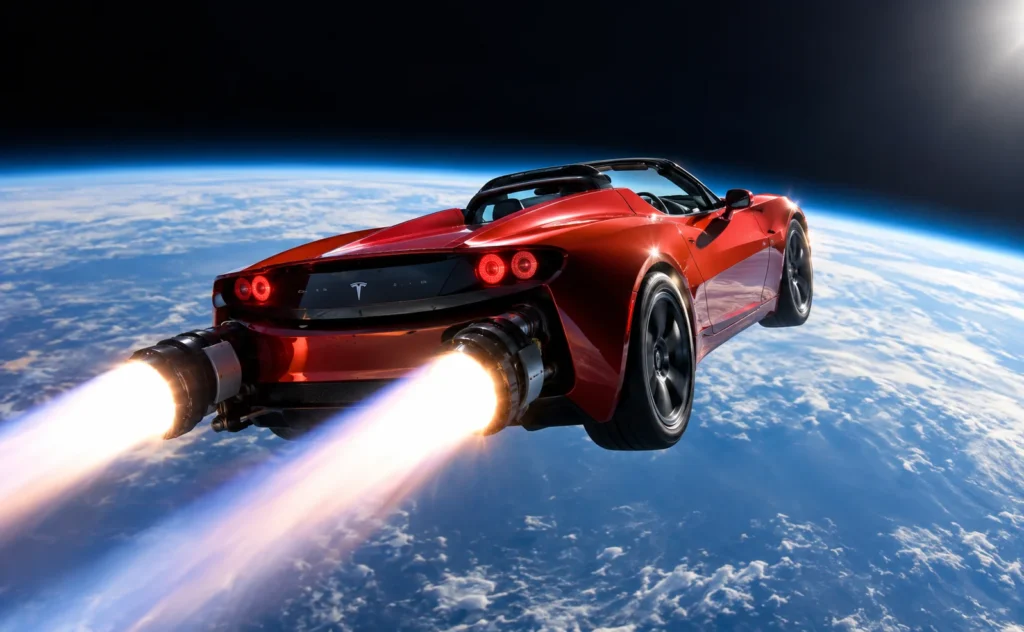
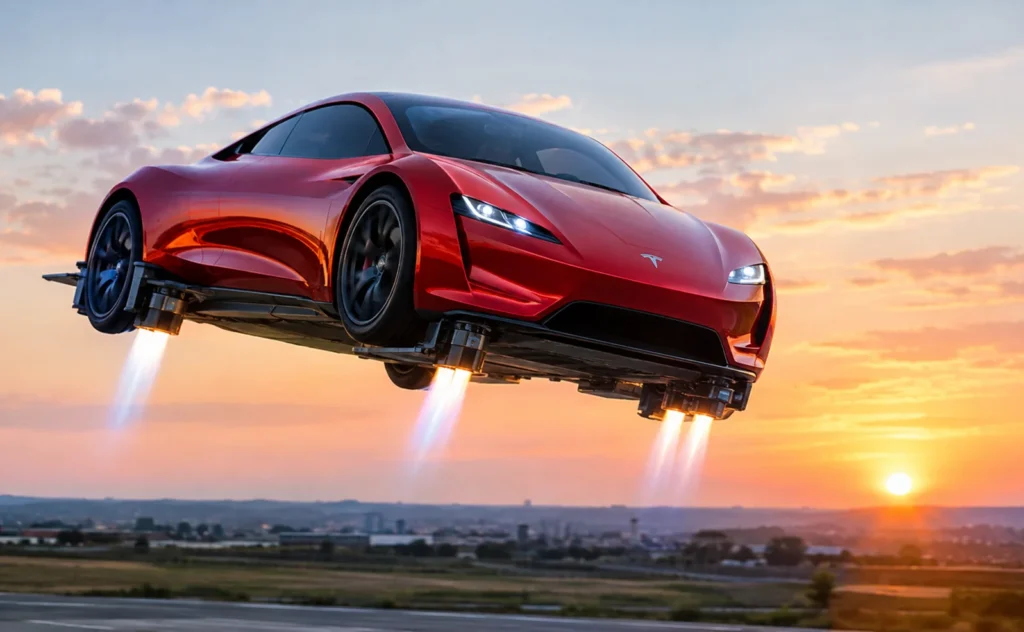
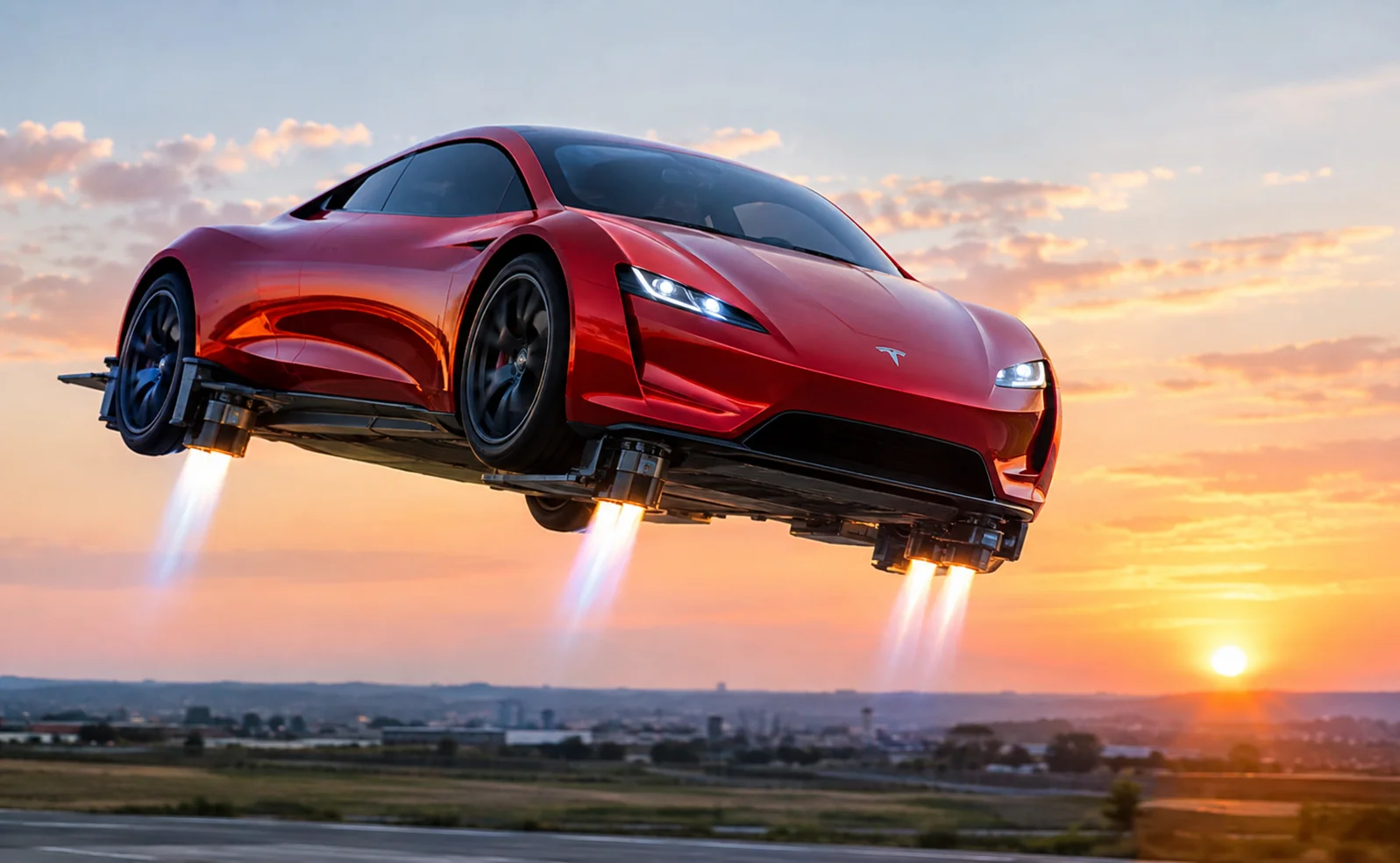
Elon Musk has brought the idea of a futuristic flying car back into the spotlight after Tesla demonstrated its redesigned next-generation Roadster at an event in Texas on October 15, 2026. The electric sports car attracted attention for a remarkable demonstration in which a prototype travelled along a curved ramp, moved upside down, performed an airborne flip and returned to the ground.
The demonstration combined Tesla’s electric vehicle technology with aerospace-inspired systems associated with SpaceX, Musk’s rocket company. It also revived an important question for the automotive industry: could a high-performance road car eventually perform controlled aerial manoeuvres without becoming a conventional aircraft?
Although the demonstration was impressive, the new Roadster should not yet be considered a fully functional flying car for everyday transportation. Tesla has presented an ambitious prototype, while important questions about production, safety, regulations and the availability of its most unusual features remain.
What Is Elon Musk’s Flying Car?
The vehicle at the centre of the announcement is the next-generation Tesla Roadster, a long-awaited electric sports car that Tesla originally introduced as a concept in 2017.
Unlike an ordinary electric car, the demonstrated version incorporates a combination of specialised systems designed to produce unusual movements. These include high-powered suction technology for travelling along an inverted ramp and compressed-gas thrusters for brief aerial manoeuvres.
During the Texas event, the prototype performed a series of stunts intended to demonstrate the vehicle’s potential capabilities. The presentation included an airborne rotation and a manoeuvre in which the car passed over other Tesla vehicles.
The demonstration was reported by international media, including Reuters, The Verge and TechCrunch.
However, the distinction between a car that briefly lifts into the air and an aircraft capable of sustained flight is important. The demonstration showed controlled aerial movement under specific conditions; it did not establish that the Roadster can take off, travel long distances through the air and land like a conventional aircraft.
How Does the Tesla Roadster’s Flying Technology Work?
Tesla’s demonstration highlighted two major technologies that distinguish the prototype from conventional electric sports cars.
1. SpaceX-Inspired Compressed-Gas Thrusters
The vehicle uses specialised thrusters that release compressed gas to generate force. In principle, directing that force in different directions can help control the vehicle’s movement during a short aerial manoeuvre.
This approach is different from the propulsion system used by a typical electric car. Conventional EVs rely on electric motors that turn their wheels to move along the road. Thrusters, by contrast, can generate force without relying entirely on tyre contact with the driving surface.
The system demonstrated at the event was associated with SpaceX technology. Musk described the vehicle as capable of performing rocket-like movements.
Nevertheless, the demonstration alone does not establish how the system will perform in every real-world situation. Questions remain about its practical range, repeatability, energy requirements, maintenance and suitability for consumer use.
2. A Specialised Suction System
Another unusual feature was the vehicle’s ability to travel upside down along a specially designed curved structure.
Tesla engineering executive Lars Moravy described a fan-based suction system intended to create sufficient downward holding force for this manoeuvre.
The concept is significantly different from ordinary road driving. A conventional car depends on its tyres maintaining contact with the road, whereas a system designed to hold a vehicle against an inverted surface requires additional engineering and carefully controlled conditions.
It is also important to understand that driving upside down on a purpose-built ramp is not the same as driving upside down on an ordinary road.
3. An Integrated Electric and Aerospace Concept
The Roadster’s demonstration illustrates how electric vehicle engineering and aerospace-inspired technology could be combined in a specialised performance vehicle.
However, Tesla has not publicly established that every feature shown in the demonstration will be included in every production model. Buyers should therefore distinguish between the capabilities displayed by the prototype and the final specifications of a vehicle that eventually reaches the market.
Tesla Roadster: Key Features and Performance Claims
The following table summarises the major details associated with the demonstration and the company’s reported plans.
| Feature |
Reported details |
| Vehicle |
Next-generation Tesla Roadster |
| Manufacturer |
Tesla |
| Aerospace technology |
SpaceX-inspired thrusters |
| Aerial demonstration |
Brief airborne movement and rotation |
| Inverted movement |
Demonstrated on a specially designed ramp |
| Acceleration claim |
0–60 mph in under one second |
| Reported top speed |
More than 230 mph for the specialised Rocket version |
| Reported driving range |
More than 300 miles for the Rocket version |
| Production target |
2028 |
| Current status |
Demonstrated prototype; production and delivery remain future steps |
Note: These figures reflect reported claims and announced targets, not independently verified performance across production vehicles. Specifications may change before commercial delivery.
Can the Tesla Roadster Really Fly?
The answer depends on what is meant by flying.
The demonstration showed the prototype leaving the ramp, rotating in mid-air and landing back on the ground. That is different from sustained flight, in which a vehicle remains airborne and travels a meaningful distance under controlled propulsion.
A conventional car is engineered primarily for movement along roads. A practical flying car would need to address additional challenges, including stability in the air, reliable propulsion, emergency landing procedures, passenger protection and safe operation near buildings and other vehicles.
The Tesla demonstration is therefore better understood as a display of specialised aerial manoeuvres than proof that everyday flying cars are ready for widespread use.
For consumers, this distinction matters. A short stunt in a controlled environment cannot establish how the vehicle would perform in bad weather, during a system failure or in an emergency outside a test facility.
How Fast Is the New Tesla Roadster?
One of the most striking claims associated with the Roadster is its acceleration.
Tesla demonstrated a claimed acceleration time of less than one second from zero to 60 miles per hour. That is approximately zero to 97 kilometres per hour.
If achieved consistently by a production vehicle under clearly defined testing conditions, such performance would be exceptional. However, a demonstration or company claim should not automatically be treated as an independently verified production specification.
The reported top speed of more than 230 mph for the specialised Rocket version is another indication of the project’s performance ambitions.
These figures also raise practical engineering questions. Extremely rapid acceleration can place substantial demands on tyres, braking systems, battery output, thermal management and passenger safety. The final production vehicle will need to balance performance with reliability and regulatory compliance.
When Will the Tesla Roadster Be Available?
Tesla has indicated a production target of 2028 for the next-generation Roadster.
That target does not mean customers will necessarily receive their vehicles in 2028. Production schedules can change as manufacturers complete engineering development, manufacturing preparations, testing and regulatory processes.
The Roadster has already experienced a lengthy development period. Its next-generation version was first presented in 2017, with its original production expectations subsequently delayed.
The latest demonstration represents a significant public milestone, but it does not by itself confirm that mass production has begun or that customer deliveries are imminent.
Prospective buyers should check Tesla’s official Roadster page for current reservation information, specifications and announcements.
Will Every Tesla Roadster Be Able to Fly?
Not necessarily.
Reports about the demonstration have distinguished between different versions of the Roadster, including Performance, Thrust and Rocket variants. The Rocket version has been associated with the most specialised propulsion features and has been described as invitation-only.
The precise equipment available on each version, along with its final price and delivery conditions, should be confirmed through Tesla’s official sales information.
There is also a major difference between offering a specialised vehicle for controlled demonstrations and selling a road-legal car that consumers can operate on public streets.
Even if a future version incorporates propulsion technology that allows brief aerial movement, that does not mean the capability will be legal or available everywhere.
Safety and Regulatory Challenges
A vehicle equipped with propulsion systems for aerial manoeuvres would face challenges beyond those associated with an ordinary electric sports car.
Passenger and public safety
Aerial manoeuvres introduce risks that are not present in normal driving. A system malfunction could affect the vehicle’s trajectory, while the release of high-pressure gas would require carefully engineered safeguards.
A production design would need to address passenger protection, emergency shutdown procedures, system reliability and the risks posed to people nearby.
Road regulations
Public-road approval depends on the vehicle meeting applicable safety and equipment requirements. A technology that works during a controlled demonstration may not automatically be permitted on public roads.
Rules can also differ between countries and jurisdictions. The legal status of any aerial capability would need to be assessed separately from approval to drive the vehicle as an electric car.
Environmental conditions
Wind, rain, road surfaces, temperature and visibility can influence vehicle operation. Any practical aerial propulsion system would need to account for environmental conditions and demonstrate predictable behaviour.
Cost and maintenance
Specialised thrusters, pressure vessels, control systems and additional safety equipment could increase manufacturing complexity and maintenance requirements. Tesla has not yet established the complete long-term ownership costs of the demonstrated configuration.
These issues help explain why a successful demonstration should be treated as an engineering milestone rather than proof of a commercially mature flying-car system.
How Could the Roadster Affect the Electric Vehicle Industry?
The Roadster is a specialised performance project, but its significance extends beyond speed.
First, it demonstrates Tesla’s willingness to experiment with vehicle concepts that go beyond conventional electric propulsion. Second, its association with SpaceX highlights the potential for technology and engineering knowledge to move between the automotive and aerospace industries.
The project could also influence how consumers think about premium electric vehicles. Buyers have traditionally compared electric sports cars on acceleration, range, handling, charging and design. A vehicle featuring specialised aerial manoeuvres introduces another dimension to that competition.
However, commercial success will depend on more than attention generated by a launch event. Tesla will still need to demonstrate that the final vehicle can be manufactured reliably, delivered to customers and supported over its lifetime.
For the wider EV industry, the Roadster may serve as an example of how ambitious engineering can attract interest. It is too early to conclude that its specialised technology will become common in mass-market vehicles.
Tesla Roadster vs a Conventional Electric Car
| Comparison |
Conventional electric car |
Demonstrated Roadster concept |
| Main purpose |
Road transportation |
High-performance road driving with specialised manoeuvres |
| Primary movement |
Electric motors drive the wheels |
Electric propulsion plus specialised thruster technology |
| Normal driving |
Designed for public-road use subject to approval |
Final production specifications and approvals remain to be confirmed |
| Aerial capability |
Not normally included |
Brief aerial manoeuvres demonstrated |
| Development complexity |
Depends on vehicle class and features |
Additional propulsion and control systems add complexity |
| Everyday practicality |
Established across many models |
Still needs to be demonstrated for the final vehicle |
This comparison does not mean that the Roadster will replace conventional electric vehicles. Its specialised design and likely high-performance positioning serve a different purpose from affordable daily transportation.
What Does the Flying Roadster Mean for the Future?
The Roadster’s demonstration has renewed interest in the possibility of combining electric cars with technology inspired by rockets and aircraft.
But several steps separate a spectacular prototype from a practical transportation product. The vehicle must progress through development, production preparation, appropriate safety testing and regulatory approval. Its final capabilities and ownership requirements must also be clear to customers.
Other companies are exploring electric vertical-take-off-and-landing aircraft, often called eVTOLs. These vehicles are designed specifically for airborne transportation and face their own engineering, infrastructure and certification challenges.
The Tesla Roadster follows a different approach: it remains an electric sports car concept that uses specialised technology for brief aerial manoeuvres. It should not be confused with an eVTOL aircraft designed to carry passengers through the air.
Whether this approach becomes commercially viable will depend on the final product, rather than the spectacle of the initial demonstration.
Conclusion
Elon Musk’s latest Tesla Roadster demonstration has brought a futuristic vehicle concept into the public conversation. By combining electric sports-car engineering with SpaceX-inspired thrusters and a specialised suction system, Tesla has shown a prototype capable of unusual movements, including brief aerial manoeuvres.
The reported acceleration and performance targets are ambitious, while the planned 2028 production timeline leaves significant development work ahead.
For now, the most accurate description is a high-performance electric sports car prototype with demonstrated aerial capabilities—not a fully proven flying car for everyday travel.
The next important milestones will be confirmation of final specifications, production progress, safety approvals and customer deliveries. Until those details are established, the Roadster remains an intriguing example of experimental automotive engineering rather than a replacement for conventional road or air transportation.
Frequently Asked Questions (FAQs)
1. What is the name of Elon Musk’s flying car?
It is the next-generation Tesla Roadster, an electric sports car demonstrated with specialised propulsion technology for brief aerial manoeuvres.
2. When was the new Tesla Roadster demonstrated?
Tesla demonstrated the redesigned Roadster at an event in Texas on October 15, 2026.
3. Can the Tesla Roadster fly like an aeroplane?
The demonstration showed brief airborne manoeuvres, including a mid-air rotation. It did not establish that the car can sustain flight like an aeroplane.
4. How fast can the Tesla Roadster accelerate?
Tesla demonstrated a claimed zero-to-60-mph time of under one second. This should be treated as a company claim until independently verified under clearly defined production-vehicle testing conditions.
5. When will the new Roadster enter production?
Tesla has indicated a 2028 production target, although the schedule and customer delivery dates may change.
6. Will the flying technology be available in India?
There is no confirmed India-specific launch or approval date for the specialised aerial capability. Availability will depend on Tesla’s final product plans and applicable Indian regulations.
7. Is the Tesla Roadster a fully approved flying car?
The demonstration does not establish approval for sustained flight or unrestricted public-road use of its aerial propulsion system. Final production specifications and relevant approvals remain important outstanding questions.
Sources and further reading